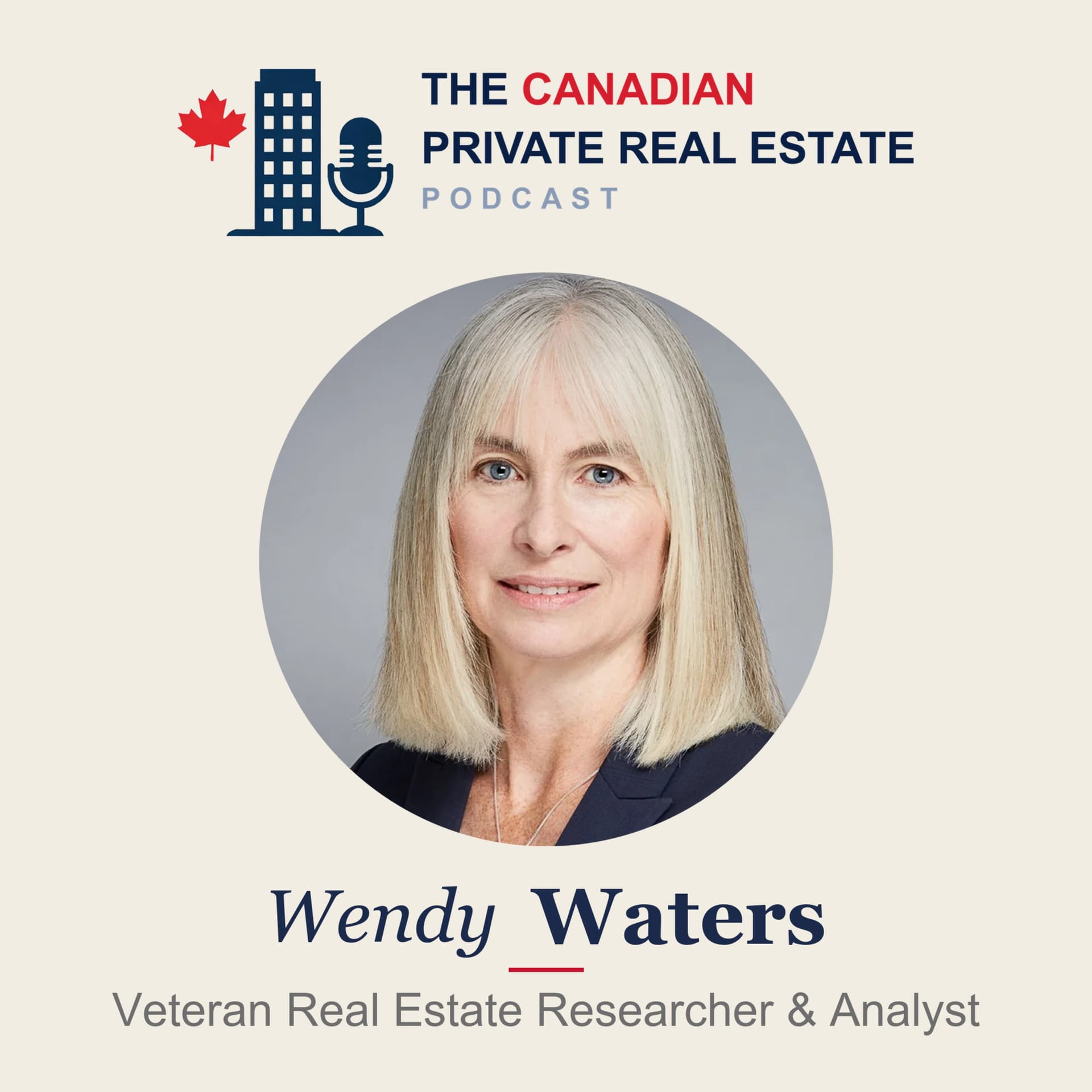
3: Beyond the Boom, A New Era for Real Estate with Wendy Waters
Guest: Wendy Waters
EPISODE DESCRIPTION
In this episode, we're joined by Wendy Waters. Wendy is a real estate research specialist from Vancouver, BC, who has over 20 years of experience in real estate research. Wendy regularly publishes research on LinkedIn, and takes part on podcasts and panels across Canada.
From 2006 to 2025, Wendy led the Research Services & Strategy Team at GWL Realty Advisors, where they provided strategic analysis on office, industrial, retail, and multi-residential portfolio strategy across Canada, focusing on the economic, demographic, and social drivers of real estate performance as well as capital flow and market trends that shape returns.
Wendy currently volunteers on the steering committee of the Urban Land Institute (ULI) of BC. Until September, 2025, she was also the Co-Chair of the RealPac Research Committee, and a member of the Board of Directors of the Urban Development Institute of BC (UDI).
Wendy is here to discuss:
→ Her experience in the real estate industry and how AI will change real estate in the future.
→ How real estate historically is used as an inflation hedge and the disconnect between how there is a demand for housing, but the current price-points it sits at is not attainable for buyers.
→ The old mantra of "growth pays for growth" - how high development charges in BC is leading to younger buyers subsidizing the older, wealthier population of current home-owners when it comes to infrastructure, leading young people hundreds of thousands of dollars behind.
→ If Ontario cutting development fees & HST for home buyers have led to greater affordability.
→ The impact of less immigration and population decline on housing including the how less non-permanent residents are affecting the rental market, Vancouver's vacancy rates, and renters finally having options.
→ The 2 key demographic shifts investors should be aware of, 25-35 year old new permanent residents and the aging Boomers, and where opportunities could be to cater to those populations.
→ The 2 risks investors are either over or underestimating, including that there's "too much housing", and the new realities of an interest rate environment where it's stable or increasing as opposed to falling.
Wendy Waters's LinkedIn: @WendyWaters
***
CHAPTERS
0:00 Intro
0:26 Today's Guest: Wendy Waters
4:25 Real Estate as an Inflation Hedge
8:32 There is Housing Demand, but the Price is Wrong
10:37 Vancouver Vacancy Rate - Renters Finally Have Options
15:18 Impacts of Ontario Cutting Development Fees & HST
16:38 "Growth Pays for Growth" Mindset Hurting Young Buyers
18:40 Impact of Population Decline on Rentals
20:04 Impact of AI on Real Estate in the Near Future
26:21 Demographic Shifts Investors Should Be Aware Of
33:42 Risks Investors are Over/Under Estimating
37:11 Wrap-Up
***
CONNECT WITH HAWKEYE WEALTH
🔗 Hawkeye Wealth Website: www.hawkeyewealth.com
📋 Hawkeye Wealth LinkedIn: @HawkeyeWealth
📬 Hawkeye Wealth Newsletter: @Newsletter
💰 Hawkeye Wealth Mortgage Fund Guide: @MortgageFundGuide
***
Read the full transcript
Transcripts are machine-generated and may contain errors. Please refer to the audio version for greater certainty. Generated 2026-08-21.
Introduction
Welcome to the Canadian Private Real Estate Podcast, hosted by Hawkeye Wealth President Justin Smith. Hawkeye Wealth is an exempt market dealer focused on finding and vetting private real estate investments for Canadian accredited investors and family offices. It is registered in BC, Alberta, Saskatchewan, Manitoba, and Ontario. This podcast is for informational purposes only and should not be considered legal, tax, investment, or financial advice. Now let's get to it.
Justin Smith: Hello and welcome to the Canadian Private Real Estate Podcast. Thank you for joining us. This is your host, Justin Smith. Today's guest is one many in the industry will recognize. I am very happy to have Wendy Waters here with us today. Wendy is very well known in real estate circles and has been a staple on real estate panels for many years, as long as I've been in the business. She spent nearly two decades leading research and strategy at GWL, where her team produced the insights that allowed them to make the best decisions possible. She's also been deeply involved across the industry with various important roles at ULI, RealPAC, and UDI. Wendy's someone who's always thinking about the bigger picture, which I find particularly important in times where there's just so much information coming at you every day that you just need to be able to zoom out. And one other thing I appreciate about Wendy — I think she loves data for data's sake, not because she has an agenda that the data serves. So that objectivity is something that I really value. And Wendy, I'm sure that sentiment is shared by many. So it's great to have you on today. Thank you for joining us.
Wendy Waters: Thanks for having me on and thanks for that great introduction.
Meet Wendy Waters
Justin Smith: To get us started, can you share a little bit about how you got started in the business and how you became such a respected researcher and analyst in the industry?
Wendy Waters: Yeah, well, actually, I got started in the business by answering an ad in the newspaper. Those things used to exist. A lot of people don't know that job ads weren't always online. Answered an ad — my name was in the Vancouver Sun — at Avison Young. At the time, I had recently finished a PhD in economic history. I taught, then I'd been in the dot-com boom and bust. We were in the bust period where everyone lost their jobs. And I was looking for a new opportunity. And I knew I liked to research, I liked to write, I liked to explain, you know, things, especially economic and social trends. And a job at Avison Young popped up that sounded like a great fit. And so I responded, and I definitely have to thank the Avison Young Vancouver leadership team back in 2001 who hired me, took a chance. But then as soon as I got there, I realized very quickly that real estate was interesting and it touches all aspects of people's lives, and that I could bring something to that world that was needed, which was that bigger perspective — global and national, economic and social trends. And how is that going to impact real estate, as well as ways of looking at what's happening in other jurisdictions and how do they compare to Vancouver? And so to maybe be able to make some predictions as to what would happen and how things would get better. And so that's where I got started, and probably first got known for it in 2003 when Vancouver was awarded the Winter Olympics. Wrote a white paper on the impact of hosting the Olympics on business growth and office demand. And that was my first foray into white papers in real estate. And again, realized that I could bring something unique and it was also valuable to the industry and to my employers. And after a few years at Avison, GWL Realty Advisors had taken notice and needed a new researcher in Vancouver and made the offer for me to move over there.
Justin Smith: Is there some prediction in your white paper that was just particularly good and turned out to be true and was something that you noticed before others?
Wendy Waters: Well, certainly the potential for positive growth two to three years after hosting the Olympics. But it wasn't right away that it puts a place on the map. And it has to be done in conjunction with a lot of economic development outreach around the world. So you're getting a spotlight put on a city because of the Olympics, and you can use that to say, hey, we're not just about sports and the Olympics and fun tourism things, we've got really talented technology talent pool, we've got people who can do, you know, fuel cell batteries, there's all the different strengths that Vancouver had that they were able to promote. And so it did actually work out. Unfortunately, it was March 2020 when we released this — Andrew Petrozzi, who succeeded me in the research role at Avison, and I actually put out a 10-year look-back on what it meant for office markets. But unfortunately, as I said, to release something in March 2020, it got no attention whatsoever. I'm not sure if it's still out there on any websites, but —
Justin Smith: Get a white paper cooking for the World Cup.
Wendy Waters: There's so many cities hosting simultaneously. And because it's diluted a bit, I'm not expecting that much of a boost from World Cup now.
Justin Smith: Yeah. Well, that doesn't even fit a paragraph, let alone a white paper. So there you have it.
Wendy Waters: Exactly. Yeah.
Is Real Estate Still an Inflation Hedge?
Justin Smith: So, Wendy, I saw a post recently on LinkedIn where you were talking a little bit about real estate as an inflation hedge. I want to start here because a core part of many people's thesis for investing in real estate is that it serves as an inflation hedge as a hard asset. And I was curious about where your research led you on this topic. Would you share some of your key findings with us?
Wendy Waters: Well, I think real estate was an inflation hedge for a couple of decades prior to, say, 2002, 2003, a time when things really changed. That was why you invested in real estate. So the big question is, well, why are you buying real estate? Why are you buying income-producing real estate? And for a long time, we didn't have cap rate compression. Cap rates stayed around the same. Cap rate basically being the value given to an income stream. And so how you could hedge inflation is just, well, as inflation increases, the replacement cost increases, so the value of your building kind of goes up with it. Rents — you can typically, if you do your rents right, you have to be good at leasing, so you need people who are good at leasing — but if you do your rents right, there should be inflation steps if you're something like industrial or office, or you change up your tenants over time and you get your steps up to cover the inflation. So for a long time, real estate was a wealth preserver rather than a place where you grew wealth. And then since about the early 2000s, late 90s, early 2000s, we've had falling interest rates, which has meant that we've had cap rate compression, values increasing for the same income stream. And so there's been a lot of value creation in real estate, which wasn't always the case, and, you know, may not be the case as much in the future. So that's one of the key things to think about: are we back in the 1990s, where you need to really work the real estate to think about it, where you want to slightly beat inflation on your performance?
Justin Smith: What's your bet?
Wendy Waters: Well, I think it'll continue to beat inflation. One of the key things is that it won't in any given year. If you bought something in 2022, right now there's a reasonable chance you're not matching inflation in your three to four year hold that you've had the asset, because values have declined and maybe you haven't had a chance to reset your rents depending on what type of product you have, whether it's rental housing or an industrial building. You need to be able to hold it for long enough. You need to be a patient investor, hold for long enough, then real estate can match or exceed inflation. But on any short term, there can be volatility. There tends to be less volatility in Vancouver compared to Calgary. It's why, you know, you often get paid a premium to invest in Calgary, but it means you have to be more patient to get that premium in some circumstances.
Justin Smith: So sometimes you'll be under inflation, sometimes you'll be over, but on average, over time, you'll come out with a slight premium.
Wendy Waters: That's been historically the case. Obviously, we had value appreciation for 25 years or so with falling interest rates. But yeah, historically, that's what real estate could do. But you have to be willing to — if it is a time when the interest rates are not moving or they're moving the wrong direction, you do have to be willing to be patient and also work the real estate. Like, how do you get your operating costs down? How do you get your rents up? Can you offer something different? Have you got the right tenants in there? Have you got the right steps for inflation? So you have to work the real estate a lot more in these sort of more uncertain, stagnant times. The 1990s were one of those, where with the fall of the Soviet Union the world didn't know what was coming where, and wars in the Middle East. And now, you know, we've kind of got wars in the Middle East again, wars in Europe. And there's a lot of uncertainty and things changing. And that's affecting interest rates, it's affecting investment thesis, and it's affecting supply chains. It does feel a lot like the 1990s.
Working the Real Estate in Uncertain Times
Justin Smith: Yeah, you're having to work for your tenants now. If you were a leasing agent in almost any asset class, maybe besides office — office has been a tougher go for a little bit longer since COVID — but in multifamily or industrial, we talked a little bit off air about not having to make outbound calls. Well, you better warm up the telephone because you're having to earn that commission now.
Wendy Waters: Yeah, exactly. The relationship-building. If you're a broker, if you're a property manager, if you're an asset manager, everybody's got to just work that much harder, I think, to get the returns on real estate. People expertise is going to be that much more important over the next decade, I think.
Pent-Up Demand — But Not at Any Price
Justin Smith: I've seen a number of posts over the years, Wendy, where you talk about pent-up demand. Of course, one of the arguments supporting residential real estate values as well as rents is that there is quite a bit of pent-up demand. I'm curious, is this a valid argument? Is the demand there? And how does one go about measuring that demand?
Wendy Waters: Yeah, I think the key thing is that there is pent-up demand for housing. We do not have enough housing. If we did, there would not be so many homeless people on the streets. But we don't have pent-up demand at any rent. So we have pent-up demand for housing, but not at, let's say, $6 a foot rents, not at $2,000 per square foot residential condo apartments. You know, how do we measure that? So how do we know that? Well, we know by the number of 20 to 39-year-olds who are still living with their parents, you know, that historically wasn't as normal. It's not normal in some other Canadian cities where there's plenty of housing. So in Metro Vancouver, for example, at the 2021 census — which was a weird year because of COVID, but the '21 census — there were over 200,000 people age 20 to 35 living with their parents. Over half of them were over 25. So they're not really university age anymore, they're beyond that. So they were just living with their parents. And then you add in roommate households, you know, people with two, three, four friends that are sharing together, which isn't most people's ideal situation, and then that adds more. And when I was in my previous role, we did have a detailed model with all of this where you could see how many people were in various pent-up demand situations. And as I said, it's not at any rents, but they are there. And so then over time — now right now, we've got rents falling in some of the new product — and what you're slowly seeing is at a certain point, new product hits the rent where people are willing to pay for new product at that rent and they lease up. You know, the people are there. It's getting it at the right rental rate, it's getting it at the right buyer price. I'm more of an expert on the rental than the ownership side, but the principle is the same, that it's hitting the right price-point sweet spot where people can afford it and they do move. And it does show us that. But that's some examples of how we know there's just not enough housing.
Record Vacancy and the "Filtering" Effect
Justin Smith: Yeah, it's interesting. I like that you added the bit about not enough housing at the right price, because Vancouver is hitting — I'm not going to say it's record vacancy, but certainly the highest vacancy in the residential markets that I've had in my career. And I don't know, is it across your career? Have you ever seen a vacancy rate like this?
Wendy Waters: I think it spiked up briefly in 2009, maybe, or maybe it was 2011, right after the Olympics, because there's thousands of Olympic gypsies — people that come to help put on the Olympics and then they go on to the next Olympics. But no, it's been nothing sustained. And if you go back — CMHC data goes back to 1990 — like, this is the highest it's been. Now, this is a pretty big wave of new supply. You know, as you probably know, as an investor, it takes time to lease up a brand new building. And especially if you're in this time of softening rents, it takes time to figure out what a new building opens at, what's the right rental rate. You know, it takes a while. And so I believe CMHC puts buildings into their inventory at around 60 to 70% leased. So I would call it not a stabilized asset yet, with a lot of units. And so that's one reason why we probably had a spike, is just there hasn't been enough time to lease up those spaces. But then also we've obviously got the fairly flat population or slightly negative population growth. And, you know, people have time. And one thing to think about with pent-up demand is that if people already have a roof over their head, there's no urgency. In 2023, 100,000 people showed up in the Lower Mainland who all needed a place to live. And most of them had money. The students had to bring $30,000, I believe it was, with them in order to be allowed in. So they had money to rent. And people coming for a job, whether they were economic immigrants or temporary foreign workers, also had a job, so they had money. And they needed to find a home. So everything just got bid up during that time. And we also had a lot of domestic migration in that 100,000 as well. People had a reason why they needed to find housing, they had money, they bid up things. Now everybody has a roof over their head. So there's no gun to your head, there's no urgency. You could play off one landlord against another. You can see what incentives show up. You can look around for a better neighborhood or a better housing situation. And we are seeing that. Renters in Vancouver have never had options like they have now.
Justin Smith: Yes.
Wendy Waters: Like, you know, I was talking to someone who manages a nonprofit rental building that has some market suites — a lot of nonprofit buildings use that, they have some market suites that then help subsidize the non-market suites. They're losing their renters to a brand new building in the area because that building's offering incentives and the people are willing to go down a size in apartment, like say go from a one bed to a studio to get that brand new building with the cool gym and the rooftop deck and the movie lounge and all of that. So renters have options right now that they've never had before. But we're also seeing something we haven't seen as much of, which is filtering, where we're getting people moving out of maybe that one bedroom suite in that nonprofit building, that market housing, into that new building. And now that leaves that unit for somebody who doesn't qualify for non-market housing but doesn't have as much income. So we're seeing filtering actually take place. It's just really slow because there's no urgency to it. But I think, you know, from a renter's perspective, this is needed. More housing. It's healthy for society.
Justin Smith: Particularly in Vancouver, Toronto. You think about the cost to society for the entrepreneurs that won't exist because they just couldn't take the risk because rent was too much, or the couple that wants a family that is not going to have kids because an extra bedroom costs too much. And I think this is a good thing, but we do need to be able to lower the cost of delivery to be able to continue supplying homes at prices people can afford. Because as you know, if it stops becoming profitable for the developer, you've got no profit motive, then what are we doing here, right? And so that's the risk right now.
Wendy Waters: As you know, some condo projects are pivoting to rental because they can still just barely feel like they can make that work with some really favorable help from CMHC. But, you know, I would say the margins are pretty tight on those in terms of what rental assumptions you're going with. And it's going to depend on the location. There are definitely going to be locations where somebody overpaid for the land relative to what the rents are likely to be, especially maybe in the inner suburbs or even the outer suburbs of the region. So, yeah, being able to bring product in — whether it's condo or whether it's rental — at that price point is going to be key, which means dropping fees, speeding things up. But then even with that, you've got labor and materials and a lot of uncertainty on what those costs are going to be. So it's certainly a challenging time. But the ability to bring in more homes at the price point that all these people in the pent-up demand situation will make them move along is key. And, you know, certainly the development charges is one conversation that probably needs to happen — is already happening — and that's certainly one way that this can happen.
Development Charges, Ontario's Fee Cuts, and Who Pays for Growth
Justin Smith: Moving on on that topic — we have seen Ontario cut HST and development fees to lower the cost of delivering real estate. What impact do you see those changes playing out in the Ontario condo and multifamily markets? And we'll talk about expectations in BC as well, because, I mean, there is no announcement for BC, but you have to think it's coming.
Wendy Waters: Yeah, I mean, I heard it was coming, just a matter of days away, at the Vancouver Real Estate Forum. There were several people that had sort of been in some rooms saying it was being actively negotiated. And yet we still — this is now, you know, what are we, April 23rd, so we're 20 days post-real estate forum, and I've heard nothing. So going to the Ontario, first part of your question — well, certainly getting the HST off initially is just going to make it possible for, I think, a lot of buyers to say, okay, I will buy that newer product. You know, HST, obviously, one is at 12%, I believe, in Ontario. So that's much more meaningful than what's probably going to be on the table in BC, because we don't have an HST. So it's definitely going to help move some of that existing inventory. Obviously, getting the DCCs down and that promise might help get some other projects going. I think that'll remain to be seen because the current fees in Ontario are still so high that even cutting them in half, it's still a pretty large number. But the taxes is definitely one that should help. Certainly clearing out the existing inventory makes it easier for somebody to move forward and think about building new.
Justin Smith: I saw you actually had a LinkedIn post — you said in Toronto, a new townhouse buyer pays approximately $185,000 in development charges. That's $900 to $1,000 per month on a mortgage every year they own the home. So, you know, if you were 50% off of that, it's, you know, $450 to $500 a month.
Wendy Waters: Yeah, it's still a lot when you start to think about this. We were talking about this a bit off air. Growth pays for growth — well, why, if these are new, younger people buying a home and we're putting $500 a month off of them to supposedly pay for growth? That's a lot of money per year that's more than what people are paying in property taxes who have been flushing their toilets in that neighborhood for 20 plus years for maybe the sewage upgrade that's being discussed, or the road upgrade, or whatever it is. So I still think that the development charge that is beyond what's needed to hook up that townhouse complex or that apartment building to the grid is something that's going to have to be thought about in terms of an equity perspective. And, you know — and by equity in this case, I mean social equity — Paul Kershaw from UBC has been posting a fair amount on this as well, of just this generational squeeze, how much policies are favoring, you know, older, higher-income existing homeowners at the expense of younger people. So there's certainly a dialogue that could be coming on that fact.
Justin Smith: But yeah, it's just a larger demographic. If you look at the people that are benefiting from lower property taxes versus the number of people that are paying the price of higher development fees, the first group is much larger than the second. And so it's just not politically expedient to cater in any way, shape or form to the second. It's just destabilizing to society when you're shouldering, typically like you say, younger purchasers with these costs. You need to have young people with a little bit of money in their pockets and to be able to take risks and to have kids. It's a bigger problem than I think most people give it credit for.
Population, Productivity, and Young Buyers
Justin Smith: We'll talk a little bit about demography shortly here. We have had a declining population, I believe this last year — maybe you can confirm that for me — for the first time since Confederation. And that population growth isn't coming from within. And so real estate, it always follows population growth. If you have population decline, then you're trying to capture an ever larger piece of a shrinking pie, which is a tough game to play.
Wendy Waters: Yeah, well, I don't anticipate we're going to have population decline for very long. I mean, we still had almost a record number of new permanent residents into Canada. It's just we're removing the non-permanent residents on a net basis as permits expire, being asked to leave — and just more people being asked to leave than coming in. So the non-permanent residents impact the rental markets more than the impact on for-sale markets, other than maybe as condo renters. But yeah, without making room for young people to own homes at a price point they can afford — you know, we're talking about innovation and creativity being down and productivity being down in Canada, and I think you sort of hit it: it's like, if you don't have that extra little bit of money to play with, or being able for a couple to go to one income so the other person can start a business — yes, that's really important. And so you've got to be able to get your housing costs down so that that can all work, and everyone working one or two jobs, both members of a couple doing that, yeah, it makes it harder for the country to get ahead, let alone the couple themselves. And then obviously to think about adding children into the mix, which is another full-time job.
Justin Smith: Yes, yes. And when you think about the next technologies that will drive the next wave of growth — I mean, AI is the topic of the last couple of years. Those younger people — I was even talking to a brother, this brother is about five years younger than me, and he is deep right now in using AI to change processes within businesses. He bought the computer, runs the models locally. He has 10, what he calls agents, off doing little jobs for him all day long, you know, sending his minions to work. And maybe he even feels a little bit old because, you know, if you go down another decade to people in their early-mid 20s, these are the people that are going to be native, that speak these languages natively. So, you know, that's probably another point: you need these people. You need these people to start businesses. So I have actually a little bit of hope that we're getting that part figured out, Wendy.
Wendy Waters: Yeah, I think the 1990s were a time where basically home prices didn't rise, and it did allow people to get into the market. You know, sort of my husband and I benefited from that. We were never expecting the subsequent rise in home prices. We said, well, we better get a house that has some rental units in it so that we can afford to live in it over the long term. But that did happen — incomes rose over the decade, but home prices didn't. And suddenly things make sense. And I think we could certainly be in that now, where we're not necessarily going to see home prices decline much more than maybe they have, but they don't grow. But we need to get that innovation happening, that income happening, the jobs happening. And AI could be a big part of that. You know, in Vancouver, tech historically has been a very big part of when Vancouver takes off and has a boom time. And jobs are really important to both rental rates and the ability to sell homes. When we've had jobs take off, it's been the technology sector over the past, say, almost three decades now that has been the driver of that. With new AI, maybe there is something there.
AI as an Analyst (and Its Limits)
Justin Smith: Are you using it at all in your day-to-day life? Are you using it on the research side? How are you finding it useful in your life?
Wendy Waters: Yeah, I'm using it. I'm trying to learn every day. You know, I guess the benefit of being restructured out of where I was at the time that it happened — which was about six months ago — was AI was changing fast, but I was given some really good advice to take a certain course to introduce me to all the tools, and then I just met some people that have given me some tips. But yeah, I use it to pull a lot of data. It's amazing how much more efficient it is. You can get, you know, StatsCan data, some CMHC data, but especially StatsCan — it can take a long time to pull it down and organize it and then be able to create a chart. And I guess people seeing how much stuff's coming out on LinkedIn from me, some of that is because I can, in the background, have Claude be pulling down census data and reorganizing it and so forth. So definitely on having AI be like an analyst for me, for sure, that's been good. And I've been working on, you know, how do I have it organized better. There's some things I've struggled with on it in terms of, say, creating charts — it doesn't seem very good at charts. And I found you've only got to watch for the hallucinations and it making stuff up. But it's way better than it was, say, four or five months ago. It's really improving on getting it right. I'm still shocked at how often an AI — I guess they're LLMs — but how often they can't do math. Like, arithmetic gets done wrong.
Justin Smith: Yes, yes.
Wendy Waters: That one still shocks me. And so I am learning one thing that's really important, I think it's going to be, as we're integrating it into real estate companies, is you're still going to need subject matter experts who recognize when it's hallucinating or something's not right, and to be continually looking at it, double-checking, spot-checking data downloads that an AI might be doing. So it's really important that you actually understand what it's doing, and then asking it the right questions. Because, you know, the superpower of maybe someone like me and probably someone like you is asking the right questions, knowing what the right information is. The AI can't necessarily do that. And so it's knowing what to ask it to do, and when it spits out 10 different versions of a chart, knowing which one's actually the one that your clients need to see. So all of it's going to need a subject matter expert. But then also, to your point about young people, there's going to need to be an AI expert, and they may not be the same person.
Justin Smith: True. No, it's true. That is your value — you know, you have a little bit more of an intuition about what's correct or incorrect and can spot things a lot quicker. I saw one the other day, someone asked Google what the average weight of a man is, and they gave it through various age categories. A 20 year old is like, you know, 160 pounds. A 40 year old is like 280 pounds. And then a 60 year old was like a thousand pounds or something like that. It just kept stepping up, right? I'm sure the young people would catch that one too, but they're not always so obvious like that. And like you say, the ability to spot inaccuracies, in addition to maybe some of the other folks becoming more prompt experts — both valuable skill sets. We're not losing our jobs entirely yet, Wendy. You know, maybe we've got a little bit more in us.
Wendy Waters: No, no, I think everyone's going to have to learn how to integrate it with their job, but also learn the limits of it and how to make whatever your superpower is stronger and make you more efficient at it. But yeah, it's going to take some jobs, or it's going to mean there's fewer people doing certain things. But yeah, there's going to need to be subject matter experts. And then AI changes so much, there's going to need to be somebody that's keeping track of that. You create an agent today, next month Claude or Perplexity or Gemini, there's going to be a new version and someone's got to update it. And if you take the subject matter expert away, you're not going to know if the fix to the AI agent is actually doing the right thing. So I think taking all the jobs is somewhat overstated.
Justin Smith: Yeah, I agree. It's moving at quite a pace. Good for you on taking the course.
Wendy Waters: Yeah, I'm looking forward to taking some more, and some of it's just a matter of taking the time and just doing it. What's great about AIs now is they actually will teach you themselves. It's like, here's what I want to do, and I say, well, you need to do this and you need to do that, and I say, how do I do that, and it goes along and tells me.
Justin Smith: It's amazing. It's amazing. You know, you almost have to rewire your brain to what you are capable of, because what you would have just said no to — you know, there's some type of IT issue or something, oh, I don't know how to reroute this DNS to this or that, and I can't do that — or can you? And people are, you know, slowly figuring out that they can do things, which is pretty cool. I'm curious to see the new industries that come out of this as well.
Demographic Shifts: Retirees, Immigrants, and Boomers
Justin Smith: A little bit on demography, Wendy — you've done a lot of research on it. What are some of the most important demographic shifts that you see coming that real estate investors should be aware of?
Wendy Waters: Yeah, I think one that people aren't talking about quite enough, unless you're reading really the nuances of some of the bank reports, is 300,000 to 400,000 people retiring in Canada every year. That's how many people are exiting the workforce. That's the anticipation, I believe that's Bank of Canada, and CIBC has also come up with a similar number. CIBC then said, well, to replace them, you're going to need about 500,000 new permanent residents per year, because not everybody who comes is going to immediately be able to work — they might be a child, they might be a spouse who's not going to work, they might be a student still trying to upgrade their skills. So needing to bring 500,000 in. And right now, that's not our target in Canada. So either people are going to work longer and they might be compensated for that — you know, someone may pay someone to stay on and keep working, so we're going to need that — or we may need more temp workers again (here we go again on that cycle), or we may need to raise the number of permanent residents, or perhaps just be more productive. That's also, I guess, more of Canada's curses, is not productivity, but we just talked about AI, that maybe we don't need to replace all 400,000, but certainly you're going to need to replace a lot. So you start thinking about, well, now we've got to bring in people. You know, the birth rate's low, and someone born today isn't going to be helpful for at least 20 to 25 years in the workforce. So going to need to bring in people. And on this, like the last five years, there's been 2 million new permanent residents in Canada age 25 to 35. So that's a prime home-buying age, that's sort of family-formation age as well, in terms of childbearing. And so that's a lot of people, and it's going to continue. An immigrant is typically in their 20s and 30s, and then maybe there's a child following them. You know, people don't typically immigrate when they're 60. They immigrate when they're young, and around the world — whether it's domestic migration, international migration — it's just the way it is. So all these people coming in, they came in in their early to mid 20s, they're going to be hitting an age where maybe they need a family-sized home, whether it's an apartment. They may have come from a part of the world where apartment living was totally normal, so it's not going to seem weird to raise a child in an apartment and/or other types of housing. We don't know what the fertility rate is going to be for this foreign-born Canadian generation — historically, I think it's often been slightly higher, but it's hard to say where it will be. But that's going to be an interesting one to watch, is that group and family formation.
Justin Smith: On the real estate side, then, your retirees — is that demand for retirement homes? For your 25, 30 year olds, that's probably rental demand for a while moving into starter home demand?
Wendy Waters: Yeah, 25 to 35 years, the people first arriving obviously rent as they get themselves settled. But I think the first-time buyer product — I mean, it'd be interesting to see in Ontario with some of these changes to make things slightly more affordable. Other than at the census, anyone keeps track of where somebody was born and where they went to school and so forth — other than every five years at the census, some of that information is picked up. So that could certainly be what we start to see, is that group is the one that starts to buy, now that they've been here a few years and they see that there's a buying opportunity with prices coming down, and maybe wanting to have that security of an owned home. But also, obviously, there's certainly a big renter demographic. So we've got that group coming in. The retirees, they don't typically go into seniors housing at age 65. So, you know, what to do with that group? The baby boomers, it's 85 to 87 when people typically move into seniors housing.
Justin Smith: What, that late? 85 to 87. That's for like assisted living type of housing.
Wendy Waters: Now, in the US, there's some of these sort of retirement communities, which are a bit more of an active living kind of thing, which I don't think we have a lot of, Florida style.
Justin Smith: Florida style.
Wendy Waters: Yeah. My parents were American. You know, my grandparents moved to someplace in Arkansas which had golf and fun activities all the time, you know, when they were still really active. But we don't have that in Canada. So it's when these baby boomers hit 85 to 87 and the big wave hits then, that's when the seniors housing demand is going to be coming. And it's probably coming fairly soon. And that's sort of related to the last demographic thing I'm going to bring up: everything about the baby boomers, every stage of life they've been through has altered the economy, it's altered society. You know, when they were all children, it was demand for the suburbs expanded and demand for all of the kinds of products you need to raise kids, and then demand for all of the university. And also, obviously, young people tend to be very socially active, and so, you know, protests against the Vietnam War and some of these other social movements that happened in the 70s. And now we've got them in retirement. What's that going to be like? And then when they pass away, that's going to be an interesting one. You know, it's still 10, 15 years away, at least, before that starts to happen. But that's one of the biggest wealth accumulations that we've ever had, is what the baby boomers are holding. And does that slowly filter down to their children and grandchildren before they pass away, or what happens? And so I think they're going to have an impact on seniors housing and there's going to be some disruption — I haven't figured out what it is — as they exit. And that was just a really unique, you know, huge baby boom, so many people, generation, to see what happens next. And there'll be real estate implications for all of it. You know, how much people are buying — I didn't mention on the 25 to 35 year olds, that's who buys stuff like retail. What do retailers want to be near? Families with kids, because you buy groceries and you buy stuff because kids outgrow it all. And so you need all of that. So that's another piece that I should just add on to that last conversation.
Justin Smith: So the boomers are sort of starting in what, born in the mid 40s, mid-late 40s?
Wendy Waters: Late 40s, so depending on whose lines you use. So they're creeping up on that 80 years old now.
Justin Smith: About 10 years out from when we're really going to see a wave that needs assisted living.
Wendy Waters: 10 years out from when we're really going to see a wave that needs assisted living. And there are a lot of them that have wealth. So I think that could be a really interesting one.
Justin Smith: A little bit more luxurious assisted living with all the amenities and —
Wendy Waters: Potentially, yeah. I mean, you start to do the math, I guess, like say 1950, you put that to today, so leading edge is in their mid to late 70s. So that's one interesting thing to come — seniors housing demand, what happens to them, and does that actually free up some single-family housing or some housing sites down the road as that group is no longer able to look after a home by themselves?
Justin Smith: Certainly. Yeah. I think the average age of my neighborhood is something like 68 years old on my entire street. You know, I've got a 10 year old — I think I might have the only child on my entire street here. I'm trying to think of another one and literally not one comes to mind. We've got a couple in the neighborhood, but on my street... So I know these people, they're my neighbors, they're awesome, but they're not going to be there forever.
Wendy Waters: Yeah, 10 or 15 years from now — your kids might be a little too old to be babysitters, otherwise — the entire street might become young families again.
Justin Smith: Yeah. Yeah. He's already done the lemonade stand. He makes hay in this demographic.
Wendy Waters: Yeah, there you go. So you got to take advantage of the demographic of your neighborhood.
Justin Smith: Absolutely. Five dollar lemonade.
Wendy Waters: We'll buy lemonade from a child, yes.
Justin Smith: Absolutely. He wants to do it every day here, and I have to tell him that he can't. Socially, you know — they're not buying your lemonade, or, you know, being nice. But anyways, I like to encourage the entrepreneurship.
Closing: Simplify to Solve Affordability
Justin Smith: One last question here for you, Wendy. What are some of the risks out there that you think investors are overestimating? And then on the flip side, if there are any risks out there that you think they're underestimating.
Wendy Waters: Yeah, I think we ended up kind of touching on some of them. I think obviously the overestimated risk is — I'm hearing people saying, oh, there's too much rental housing, whether it's here, Toronto or other places, or too much housing. I'm saying, no, it's just a price-point question. And people are going to shuffle around, prices will hit. So there's a need for housing, it's just getting it there at the right price point. The other one is not fully underestimated, but I think not fully appreciating the impact of not being in an era of falling interest rates. That interest rates, I think, are going to stay range-bound, plus or minus 100, 150 points where they are now for the foreseeable future. And when you had the falling interest rates, it meant cities could keep grabbing those development charges and people could keep paying the price of a new home, a new condo, because the mortgage rate went down. Falling interest rates meant that your sale price could go up because your mortgage rate changed, so your mortgage payment didn't change. And this meant that governments were taking money and using it for various pet projects. And, you know, there's thousands more municipal employees in the region than there was 20 years ago, and most of us probably aren't thinking that we're getting, you know, 20 or 30 percent better service from our municipal governments with the 20 or 30 percent more people that work there. So that time of falling interest rates, it just meant you could have development charges go up. It also meant that there were a lot of regulations on housing to make it more luxurious. And again, you could do it, or you had to do it because of what you were charging — you had to put in the more luxurious features. And I think people are appreciating, like, if we want to get costs down, we're going to need to think about how do you reduce the amount of regulation to let a developer say, hey, my target market doesn't care about having — let's use it for rental — digital balconies; if they could save $200 a month in rent, we'll put a rooftop deck, we'll put a small common room, and that is it. And they want something cheaper. And if the developer gets it wrong, then they'll have to charge even less rent. Well, now we've just solved our affordability problem, because it's a simpler product. But I think that long-term falling interest rates, so many things got distorted by that, by people being able to afford more condo or being able to extract more fees. And we also had during that time some pretty strong wage growth, which again, on the rent side meant you could charge more. So I think that's the thing — having to simplify our lives and simplify our building code and simplify the kind of homes we build, and maybe it's lowering some expectations, which is tough to do. But, you know, if we want to get a roof over everybody's head, if we want there to be some choices for renters and buyers, one choice could be something simpler that's less money. And, you know, you think back 30 years and a first-time buyer product was not a luxury penthouse condo, it was a fixer-upper. And, you know, to think about that equivalent product that might need to be freed up as we go forward.
Justin Smith: That's a great point. We've built up all of our expectations and our systems around a declining interest rate environment. And it can only drop so far when we're at whatever we're at today, right? I think bank prime, whatever it is, 4, 4, 5, like the bond rates, depending on how long the bonds are, kind of that 3, 4%. And so that's not like going from 15% to 0%. If you go from 3 to 0, it's just not the same movement, especially when the prices are already so high. So no, you're right, it's going to require a lot of innovation. Well, Wendy, thank you so much for joining us today and sharing your insights. If anybody would like to see Wendy and her great insights here, I'd recommend following her on LinkedIn. She's always putting out information that makes me think. So again, Wendy, thank you very much for joining us.
Wendy Waters: Thanks so much for having me. This was a lot of fun.
Justin Smith: Thank you for listening. As a reminder, this podcast is for informational purposes only and should not be considered legal, tax, investment, or financial advice. Any forward-looking statements are based on opinion and are not guaranteed. Hawkeye Wealth has no obligation to update them. Investing in private equity is generally considered high risk, with potential for illiquidity or a loss of capital. Most of our investments are only available to accredited investors. As such, a suitability assessment is required prior to any investment through Hawkeye Wealth.
This podcast is for informational purposes only and should not be considered legal, tax, investment, or financial advice.