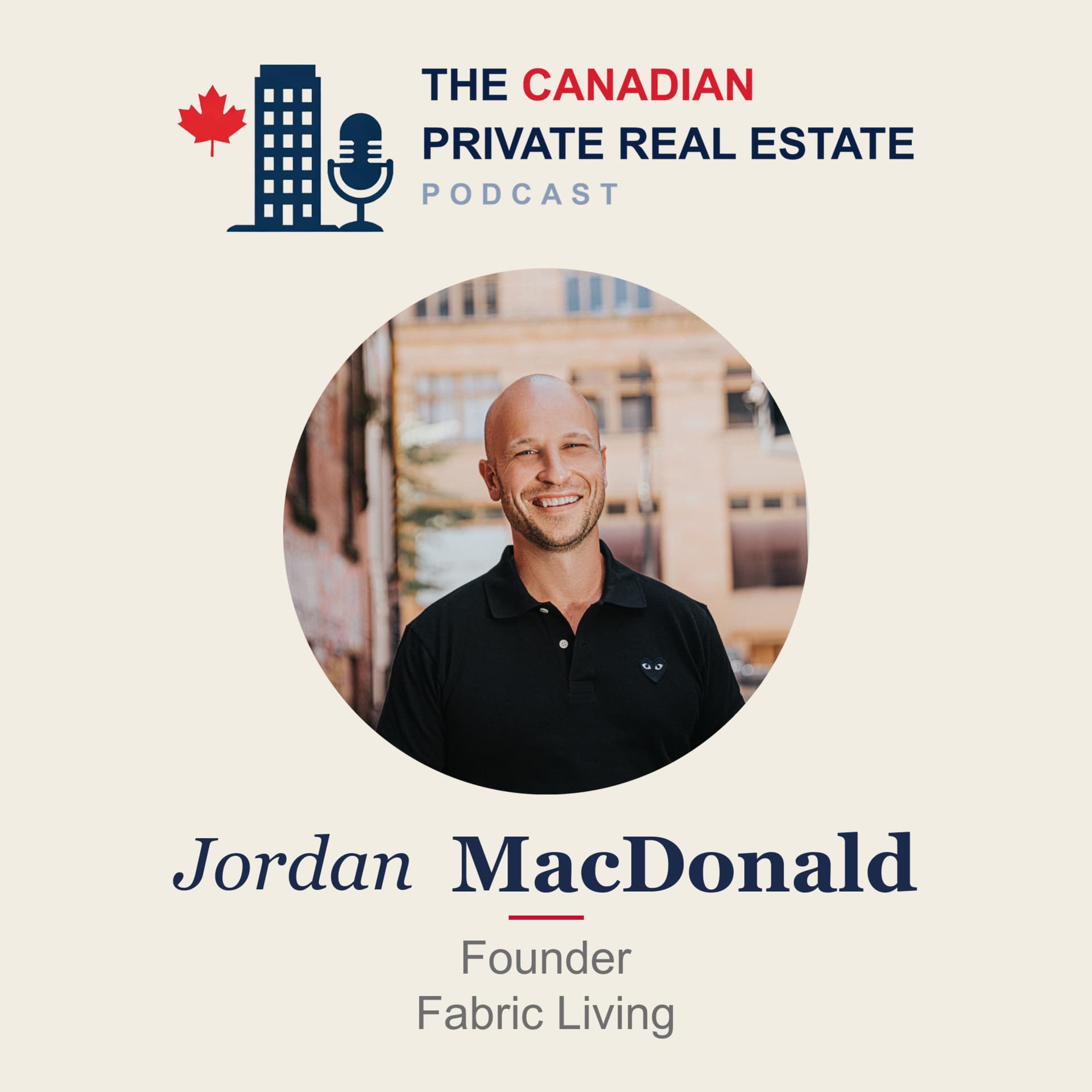
1: Vancouver's Shifting Multifamily Market with Fabric Living's Jordan MacDonald
Guest: Jordan MacDonald
In this episode, we're joined by Jordan MacDonald. Jordan is the Founding Partner & CEO of Fabric Living from Vancouver, BC, who's career in the real estate industry spans over 20 years.
Jordan began as a Junior Analyst at CBRE, followed by 5 years at Cushman and Wakefield as a Sales and Leasing Broker. He then co-founded Frontline Real Estate Services, a multi-disciplinary commercial real estate brokerage based in the Fraser Valley, spending 5 years building Frontline into a market leading commercial real estate brokerage in the Fraser Valley Region before exiting to follow his passion to be a real estate investor and developer.
Jordan founded Fabric Living in 2015, and along with leading the team and overseeing all aspects of the business, his key responsibilities at fabric include sourcing new acquisition opportunities, project envisioning, capital raising, nurturing strategic partnerships and planning Fabric’s future.
Jordan is here to discuss:
→ His journey in real estate so far, co-founding Fabric Living, and the meaning behind their slogan, "not boring".
→ Trends in the Vancouver multi-family development market including condos, CMHC, and the effects of government and immigration policies.
→ If developers are leaving the lower mainland, the questions surrounding Vancouver's rental rates, and the future of the area's housing supply.
→ 3 strategies he's using to respond to market trends involving condos, townhomes, and low-risk, high-reward deals.
→ What he's most optimistic about in the current market and the implications of AI on real estate development.
→ The grit required to survive the tough markets and the best early career advice he received - the harder you work, the luckier you'll get.
Fabric Living Website: www.fabricliving.ca
Jordan MacDonald's LinkedIn: @JordyMacDonald
***
CHAPTERS
0:00 Intro
1:34 Fabric Living & Jordan's Journey
4:38 Fabric's "Not Boring" Slogan
6:14 Developer Market Trends
9:10 3 Strategies for the Current Market
14:08 Developers Looking Elsewhere
18:13 Gritting Out the Tough Markets
20:59 Most Optimistic in the Market/Vancouver Rental Rates
25:51 AI's Impact on Real Estate Development
30:08 Best Early Career Advice
***
CONNECT WITH HAWKEYE WEALTH
🔗 Hawkeye Wealth Website: www.hawkeyewealth.com
📋 Hawkeye Wealth LinkedIn: @HawkeyeWealth
📬 Hawkeye Wealth Newsletter: @Newsletter
💰 Hawkeye Wealth Mortgage Fund Guide: @MortgageFundGuide
***
Read the full transcript
Transcripts are machine-generated and may contain errors. Please refer to the audio version for greater certainty. Generated 2026-08-21.
Introduction
Welcome to the Canadian Private Real Estate Podcast, hosted by Hawkeye Wealth President Justin Smith. Hawkeye Wealth is an exempt market dealer focused on finding and vetting private real estate investments for Canadian accredited investors and family offices. It is registered in BC, Alberta, Saskatchewan, Manitoba, and Ontario. This podcast is for informational purposes only and should not be considered legal, tax, investment, or financial advice. Now let's get to it.
Justin Smith: Hello and welcome to the Canadian Private Real Estate Podcast. Thank you for joining us. This is your host, Justin Smith. I'm grateful to have Jordan MacDonald here with us today, the founder of Fabric Living, a developer here in the Lower Mainland. We've actually done business with Jordan before and appreciate his knowledge and approach to the business. Jordan is one of those guys that everyone in the industry just seems to know and speak highly of. I know this because when we started working together, we tried to find dirt on him as part of our due diligence process. And usually we can find a little bit on most people. But we just couldn't find any on you, Jordan. In fact, it was very much the opposite. People very much encouraging us to do business with you, which is a testament to what you're building over there at Fabric and who you are. So thank you very much for joining us. It's great to have you. How are we doing?
Jordan MacDonald: I'm doing really good. Thanks a lot for the kind words. I suggest you keep digging. You might find some dirt. I think if you dig deep enough, everybody's got a little bit of dirt. Thanks a lot for having me on. And I am very excited to be the first guest of your podcast.
Justin Smith: Yes, you are. Well, we're very excited to have you as the first to get us started. Jordan, can you tell us a little bit about Fabric Living and your journey to get to where you are today?
Meet Jordan MacDonald and Fabric Living
Jordan MacDonald: Yeah, of course. So Fabric Living, we're a multifamily real estate developer. We focus on doing urban development projects, both condo and purpose-built rental. And, you know, just really kind of cool, creative projects that we can wake up every morning super passionate about working on. And we've really been focused in East Vancouver for the most part, although we're starting to focus in some other areas at this point in time, which we can talk about a little bit later in the podcast.
But to backtrack a little bit, how Fabric came to be — I've been in the business for about 20 years now. I started my career at Cushman & Wakefield, which at the time was called Royal LePage Commercial, which was owned by Brascan, which was the predecessor to Brookfield. And then Royal LePage Commercial was sold to Cushman & Wakefield. So I was an industrial broker there and I kind of started diversifying into all sorts of different brokerage, doing investment sales, a lot of land assemblies. And then a couple years in, I had a listing for sale that I couldn't sell, and so I approached the vendor of the property and said, hey listen, if I buy this property for the same price that we had it tied up at with the last purchaser who dropped it, would you sell it to me? And they agreed. And so I ended up buying that building, put together a little syndication. It was a 23,000 square foot multi-tenant industrial building. And it was sort of an oddball deal. Average unit size was about 580 square feet. So we did a paper development and we subdivided this building into 40 separate kind of mini storage slash mini bay warehouses — 40 units across 23,000 square feet. Yeah. So it was really kind of a funny building and you don't see too many assets like this, but the idea was to stratify the existing building. And so we kind of got lucky by not stubbing our toe by needing to do any major building upgrades. We ended up stratifying the building and selling it off over a two-and-a-half-year period and made some good money.
So that set me on a course to essentially getting into the principal side of the business. So I ended up starting a commercial real estate brokerage company in 2009 after being with Cushman & Wakefield for about five years. That company was called Frontline Real Estate. And the idea was to basically build a brokerage company out so that over time I could buy my time back and have money to invest in doing my own deals. And over about a five-year period, that business was really growing. It was becoming quite successful, but it was really sucking my time into doing brokerage and not doing my own deals. Towards the end of 2014, beginning of 2015, I ended up getting bought out of that company and then focused on doing my own syndicated deals on the principal side of the business. And that was buying existing value-add properties, and that sort of evolved into doing ground-up developments, and over time started to grow a team. So at this point, we're still quite a small team. There's 12 of us. There's four partners here at Fabric and we've got probably about 600 units between the projects that we've actively constructed and delivered and new projects in the pipeline right now, and continuing to grow that.
"Not Boring" — Fabric's Philosophy
Justin Smith: You talk about doing kind of cool and unique projects. I believe your slogan at Fabric is "not boring." How does that manifest itself in a development company? It seems like you're alluding to the fact that most development companies are inherently boring, perhaps.
Jordan MacDonald: It's deeper than that, I would say. I don't think that it's a stab at other developers or anything like that. It's more just about what's our purpose, like what's our why? And I think a lot of companies and people have a really difficult time digging into like, why is it that they do what they do? And we all do what we do for a reason, right? And so it took a while for us to really peel back the layers to understand why we wake up every morning and bang our heads against the wall and try to deliver these really cool interesting projects that are a little bit outside of the box. At the end of the day, it just came down to the fact that we think that people should live super exciting, interesting lives. And if you wake up super passionate about what you're doing, then whether the market's on fire or burning in the wrong direction, you can still wake up and go into the office and work on projects and be super passionate about the work that you're doing. And that shows up in the success of the projects, I think. So at our office, I mean, if you tour our office, which you have, you see that it's super creative, it's funky, it's inspiring. And we want people that are working at Fabric to live not boring lives. We want people that are buying homes in Fabric developments to live not boring lives. We want tenants to live not boring lives. And we just think that it's a really good way to live your life, to really want to get the most out of it. It's in the DNA.
Market Forces: Supply, Immigration, and the Condo Glut
Justin Smith: It's in the DNA. Can you tell us a little bit more about the trends that you're seeing in the markets right now and how developers are adapting to them?
Jordan MacDonald: There's been a lot of forces at play here. When you're developing a real estate project or you have a real estate development business, it's like we're trying to steer a freighter. But with the amount of policy changes that have been thrown at us from federal, provincial, and municipal levels, it's like we're trying to steer this freighter through a go-kart track. And so, you know, policy changes that are favorable or non-favorable are all still requiring us to try to steer this ship in a very tight maneuver, which is challenging.
But I'd say if I had to zoom out and look at what are some of the bigger factors, you go, well, you know, immigration is down. We had negative population growth for what I think is the first time in the history of our country. And at the same time, we kind of came off of record immigration growth with the promise from the federal government that we were going to continue to see record population growth with immigration, and a promise from the feds to keep interest rates low. And we were incentivized as a development community through CMHC financing to deliver a lot of product for all the people that were going to be moving here. And so a lot of new supply is getting pumped into the system, a lot of new supply is being proposed, which is being delivered at a point in which the actual population is declining. So you have more beds being delivered than heads that need them. So that is probably the biggest issue, I would say, in the multifamily development industry right now.
I'd say another thing that we're seeing is condo deliveries are really starting to pile up with completed units that are unsold. And I was at a Rennie event a couple of weeks ago, and they're kind of showing a graph of sort of like a, you know, worst case, likely case, and, you know, more of an optimistic case. And then over the next couple of years, there could be anywhere from, you know, 4,000 to 8,000 units of unsold inventory.
Justin Smith: That's just Vancouver.
Jordan MacDonald: That's right. And so if you're an investor looking to buy a condo in pre-sale, you're going to be looking at that and you're going to say, OK, well, if I'm going to buy this pre-sale condo, I have an interest in making money off of that in some way, shape or form. Maybe it's a capital gain or it's by renting it out long term. But the capital gain is something that's going to come into question because you're going to go, OK, well, there's 8,000 or 4,000, 8,000 units of unsold inventory that I'm going to be competing with. So what is the demand for that product going to be when it's actually delivered? And if I'm renting it out, now I'm competing with an entire industry of developers that are building the majority of new product as purpose-built rental. So the reason that that is a big issue is because that investor that is probably not super stoked about going and buying a pre-sale for those reasons, they're the ones that basically got developers to their 50 to 65% pre-sale requirement to actually get their projects financed and out of the ground. So the condo market is really challenged as a result of that. In particular, the vertical condo market.
Adapting: The Purpose-Built Rental Model
Justin Smith: So how do you adapt in that environment? How do you respond?
Jordan MacDonald: Yeah, we've been really working on our purpose-built rental model so that we are not just a typical commodity. And this really comes back to the DNA of our company, which is not boring. The alchemy of what we create for our purpose-built rental projects is basically these seven different things that come together to make one of our projects super interesting. And I would say differentiates it from like a typical commodity product. So we try to be in like really amazing neighborhoods like Mount Pleasant, super walkable. We want our unit sizes to be more compact, our amenity areas to be amazing. And not just to say, okay, let's get into an amenity war, and we have 20,000 square feet of amenities versus 25,000 square feet of amenities; is doing the everyday amenities right and really bringing in like a highly curated design to it so it feels like you're in a boutique hotel. So there, your unit may be smaller, the actual common areas of the building is where people do the majority of their living and socializing. And so when your unit size is smaller, we are able to achieve a price per square foot alpha while keeping the actual quantum price point of those rental rates down for the actual tenant and what they're paying on a monthly basis.
And so we also think about how can these buildings provide a lifestyle for people where they don't need a car. And if people can delete a car from their budget, that's a pretty significant expense. If you think about car lease and gas and parking and maintenance and washing, et cetera, that's easy $1,000 a month that you can pull out of somebody's budget. It has a much more material impact on somebody's living budget than getting their rent down by $200 a month. So we're looking at people's financial health. We're looking at the experience of the buildings that we're delivering. We're looking at the neighborhoods that are sort of a continuation of that experience and really trying to take our purpose-built rental projects away from like a commoditized experience — so a really highly curated, almost boutique hotel experience. So I'd say that's what we're doing on the purpose-built rental side of our business. We have two projects — one's in rezoning and one we're going to be starting construction on in the next six months or so.
New Strategies: Fraser Valley Townhomes and Opportunistic Deals
Jordan MacDonald: And then we're rolling out two additional strategies with our company right now. So the first one is we're looking at slab-on-grade townhomes in the Fraser Valley and kind of 50 units plus. And the reason that we really like that product is that you can deliver a three-bedroom home with a garage for under a million bucks. If you're under a million dollars and you're a first-time home buyer, as we know, you can get the full GST savings. GST is a big hit for a new home buyer. It's not something that people don't think about. So we see a really good opportunity to deliver housing at a price point where there's GST savings, housing at a price point that's more connected to what household incomes are generating today. And then also in the Fraser Valley, we feel that there's a higher level of family creation where there's more kids being had out there. The immigration that is coming into the Lower Mainland is finding its way into the Fraser Valley, so we like that from a price-point achievability perspective.
The other thing that we like about it is that it's less of a commodity because there's only so much land and it's more of a horizontal development opportunity. Whereas in Vancouver as an example, or other parts of the Lower Mainland, the density has been commodified, because before there were very few sites where you could actually achieve density. But with all of the new policies that have then sort of forced down the pipe, almost everything is at nodes and multiplexes and the likes — transit nodes, multiplexes, urban villages, the whole kitchen sink kind of got thrown at it. And so, you know, if you had what you thought was an A site, with everything being a development site now, your A site's probably a B site, your B site's probably a C site. And it seems like there's almost an infinite amount of density that has been created out of thin air, figuratively and literally. So when you're looking at horizontal development, you don't have that same infinite supply that could be delivered because it's horizontal. There's only so much land. There's sort of a pace at which land can actually be serviced to deliver it. So we feel that it's less of a commodity and that the price point is really at an achievable price point.
The third strategy that we're working on right now is more of an opportunistic strategy. And that's basically looking at income-producing deals where we see a really good risk-adjusted return. And I think that we're a little bit more agnostic on asset class. We're more agnostic on geography. We see so many different deals in our office where we've had the luxury of kind of doing different types of deals. We've done industrial, we've done office, we've done multifamily, we're developing multifamily rental and condo. So we see all sorts of asset classes. And then, you know, we were kind of saying no to things that wouldn't fit within a specific mold. But we realized that there's a lot of opportunity that we're passing up as a result of that. So we're starting to look at more income-producing properties where we see a really good opportunity to generate good cash flow and good upside inside of a three to seven year period.
The Development "Moat" Is Closing
Justin Smith: Do you see a lot more developers looking elsewhere from the Lower Mainland that might have traditionally only looked at doing business here, that just feel they can't make the numbers work and are forced to look elsewhere? Is that sort of what's happening here?
Jordan MacDonald: Yeah, I mean, a lot of developers have gone to Alberta. I think a lot of developers are kind of poking their head up and looking around and trying to find greener pastures. I think there is a lot of uncertainty as to how much product will actually be developed. There's a lot of new rental housing in particular being proposed. How much of that gets delivered is really the big question. But we like to call it a moat, in Metro Vancouver and in particular Vancouver used to have this moat to development: if you bought a site, it was going to take you, you know, somewhere between four and seven years to deliver that. So if you bought a site, you could have a good understanding of the moat and how much product could be delivered, and you knew that your absorption wasn't a risk, and typically your revenue wasn't much of a risk as well. But — the land use policy that's been overlaid for higher density: so many developers and/or just landowners have basically put in rezoning applications to solidify the density that has been attributed to their land under new land use policies. And so what happens is those projects slowly start advancing and the moat starts closing a little closer and closer. So the actual timeline to delivering a project is much shorter than it would have been. So it becomes more like a Calgary market almost, where if the market does turn and the economics of these projects improve, the amount of time it will take for these projects to get delivered will be much faster than they would have been historically.
Justin Smith: Yeah. Because it's not process holding it up. It's just math. And if the math changes —
Jordan MacDonald: Exactly. Exactly.
A Coming Supply Pocket
Jordan MacDonald: One thing that we do see — or at least, you know, maybe we're being optimistic because we're developers and we have projects in the pipeline — we think that it's going to be really difficult to capitalize projects, specifically from an equity perspective, throughout 2026 through 2027. 2025 was difficult as well. So there's sort of a three-year window there where it was really challenging to equitize your projects. And so starts are coming off. And as a result, we think that there's going to be a bit of a supply pocket that shows up like in 2029, 2030, 2031, even though if you were to look at the proposed supply that's working its way through the rezoning pipeline, you go, oh my gosh, look at all the supply that's going to be delivered in those years, it's going to be a bloodbath. But we actually don't think a lot of that product is going to get out of the ground because the equity is very scarce to actually deliver that type of product. So we're feeling optimistic that there's going to be a couple of years there where there's going to be a bit of a supply pocket, and call that 2028, 2029. We're optimistic that immigration is going to start to come back in a more balanced way, but we're going to see it come back around that time because, you know, at the end of the day, this country cannot function on negative growth. It's always been a country that has built itself on immigration and we need those new immigrants. You know, there's a lot of rhetoric out there about, you know, did we have the wrong type of immigrants or whatever? I don't know. I don't care about that. Like, I love the story of the immigrant that came over here with a thousand bucks in his pocket and is now the multimillionaire that made it from nothing. I mean, who doesn't love that story? So I think that immigration is something that we need to get back on the gas with. But I also think that we need to make sure that there's opportunity for them over here when they do come.
Justin Smith: Yeah, the demographics dictate that we're going to have to get back to immigration at some point, because all of our social security is reliant on having a certain number of working-age people in the population. And so, you know, you end up with the Japan problem if you wait too long. And I don't think that's anything that we want here in Canada. But we'll see. There was a lot of pressure on government to lessen the immigration. And it's funny because we see it play out that what is right for the country and is a good thing may not be good politically. And so, you know, you can get these dynamics that are challenging for governments to navigate.
Grit in a Tough Market
Justin Smith: You talk a little bit about grit, and there's not a lot great about a tough market. And it is tough and it has been now for at least, you know, two, three years. One silver lining of that, though, is if you have been participating in deals or if you've kept an eye on things, you get an opportunity to see how people perform in a situation where that grit is required, and it really can help the cream rise to the top. And, you know, if you ask me whether I'd rather have that or I would rather a massive tailwind making all of our projects make a lot more money, I'd probably still take the second. But who knows, maybe over the long run, you know, there's a bigger benefit to seeing who is worth partnering with and who isn't.
Jordan MacDonald: It's a good point. Obviously, we all want the tailwind. If you can pick the macroeconomic strategy and win every time, then you'd probably be a multi-billionaire by now, as would I. But at the end of the day, we don't know. We think that we know, but we don't. And things happen. COVID happens. And when COVID happened, who would have thought that could have happened? And I remember going, oh my gosh, like, what are we going to do? How are we going to even get financing on these projects? Are they even saleable? And this is at the beginning of COVID where it was frightening. Like some people were like, oh, I didn't do much work; I was like glued to my phone working every day, like 14, 15 hours a day. And so COVID went really fast for me, but you zoom forward, like from March to, I guess it would have been like June, July — within those months, we went from like, oh my gosh, all of our projects are feeling like they're doomed, to having record sales values and absorptions on a couple of our projects. So you just don't really know. And so there's all sorts of things that can come and hit you and you think it's terrible and then it's good, or you think it's good and then it's terrible. So it's really hard to think that you can pick the macroeconomic trend every time. So I think that it really needs to be coupled with the sponsor that you're riding with, because they're going to be the ones that either roll up their sleeves and dig in and push forward, or they're going to be the ones that fall over and die and give up their chips and just pack it up. So I think the grit side of it is something that needs to kind of show up in a sponsor like every day, and these projects take a lot of work. One of my projects, it's a ground-up development project, the incoming emails that I had associated with that project — because I sort them all into one folder — was like 60,000. There's a lot of work that goes into these projects every day. And you know, between those 60,000 emails you can calibrate it over time in the right direction, even in a top market, or you can calibrate it over time in the wrong direction.
Justin Smith: So you should do revenue per email, you know? I wonder what that would look like for you.
Jordan MacDonald: No, so — no, it's a great point.
Looking Forward: Assumptions and Uncertainty
Justin Smith: You talk a little bit about not knowing what the future holds, which anybody that's been in the industry for a while now, you know, one of the things they either learn from somebody else who's been through a lot or they learn it the hard way is the future doesn't unfold the way you think it's going to. That being said, our business is very much forward-looking and has you trying to make the best assumptions that you can about the future in order to make the best decisions you can on a probabilistic basis. Are there any assumptions out there right now that when you go looking forward, you might be more optimistic about than the market? And then we'll do the flip side as well — any assumptions out there where you feel less confident, where, you know, that might not be the case for others?
Jordan MacDonald: Yeah. Well, I'd say on concrete construction, we are seeing those numbers come down on the cost side. I'd say that's probably the first time in my 20-year career that I've seen that. Even in the GFC, you know, costs might've come down a little bit, but they kind of leveled and then kept going. And this is primarily for concrete construction, not for wood frame construction, but costs are off by five to 10%, which is material. Because when your construction costs, like your div 1 through 16, are like $5.50 a foot, and that comes off by $50 a square foot, that has a material positive impact to the bottom line.
On the flip side to that, you know, the most debated thing right now is rental rates when you're talking about Vancouver multifamily real estate, because that's basically all the new product that's being delivered right now. And we've been seeing month-over-month declines in rental rates. And that is this big question: are they going to continue to go down, are they going to flatten out, what's going to happen? Typically when you're underwriting a rental pro forma you would have trending for both your rental rates and your costs, and so we would typically trend anywhere from two and a half to 3.75 per year to account for the fact that the project is going to be delivered in, let's say, 2029 or 2030. So over time your costs are going to go up and your rental rates are going to go up. It's accretive to the bottom line, because when your rental rates are going up it's on the revenue, and when your costs are going up it's on, you know, a smaller basis. So it would create more opportunity there. But now the equity markets are really pushing back on rental rates. You know, they want no growth or flat growth or negative growth. And everybody kind of has their own elixir of what they want the trending to look like in a pro forma. And I just don't think anybody really knows at this point.
Justin Smith: And out of curiosity, the groups that you're out there talking to, what are kind of the most pessimistic rental-rate-growth numbers you're seeing out there for the next number of years? And what's the most optimistic? What's this range?
Jordan MacDonald: Yeah, I would say the most pessimistic would be to use 0% rent growth over the next, you know, four years or maybe even five years. Actually, I shouldn't say that. It's not even 0% rent growth, it's use today's rents — but I would say at a very commoditized rate level as well. So it's saying, okay, what is like — oh, not "not boring" premium. Yeah — like we're talking about, okay, this is the band, and let's focus on the bottom of the band, and then let's use today's numbers, and let's use construction numbers of 550, not the, you know, 450 to 500 that they could be. And so it's sort of picking all of these negative assumptions and putting them together, which we all know when you're working on a pro forma, you pick enough negative assumptions, or at least negative on the scale, and mix those together, then the project's going to be upside down. So I would say, yeah, it's probably more like just using the bottom end of today's rents and using like kind of yesterday's construction pricing.
Justin Smith: Yeah, and it sounds easy to know what today's rents are, but when you start digging into, you know, all the nuances between different buildings, different locations, and then you have different buildings in lease-up as well — if you're building a new building, are they giving, you know, the month free or two months free? It can be quite a challenging thing to nail down what today's market rents even are, which, like you say, is why you end up with some band, and that band, you know, might not be a really narrow band. It might vary quite widely. The other thing too is I don't know what people are using for occupancy these days, but it used to be back in the day, we'd see pro formas with 1%, half a percent vacancy allowance for a project. And I don't believe that's the case anymore. Is that what you're seeing as well?
Jordan MacDonald: Yeah, that's definitely jumped up. I'd say that it's anywhere from two to 3% right now. It's still not getting into the fives like you might see in Alberta, but I'd say it's definitely not half a percent. It's not 1%. So it's, I'd say, somewhere between two and 3%.
AI, Self-Driving Cars, and Robotics in Real Estate
Justin Smith: Switching gears a little bit on this one, do you spend any time thinking about the implications of AI on developers either directly or indirectly these days? Do any of your neurons get dedicated to this?
Jordan MacDonald: I think, I mean, real estate development, any business is talking about AI right now and how it can help us essentially. Like we're trying to figure out how to make our office and our administration within our office more effective with AI. Although I don't think that we're looking at like our physical projects and how AI is going to impact them. I think that the actual construction of our projects may have an opportunity to be more efficient when it comes to drawing reviews, et cetera. But I think it's more on like the administrative side of the business, on how we can do more with less and just run a more lean, efficient organization from like a human capital perspective. I haven't seen like a huge amount of opportunity in our space to be impacted by AI. And we have talked with a couple of different consultants and some venture capital companies that are looking at developing AI that's specific to real estate development and construction. But yeah, I know that you're really into AI, so I'd be interested in your perspective on it.
Justin Smith: Yeah, I don't know if we have a forward-looking statements disclaimer at the beginning of the show or not, but it's about as forward-looking as you can get. I have no clue ultimately what the impact will be. I just have a pretty strong conviction that it's going to be big. I think the self-driving cars are going to have an impact.
Jordan MacDonald: That is a good point, actually. That is something that will, I think, positively impact the reduced parking ratios that a lot of new projects are having these days.
Justin Smith: Well, definitely. And my understanding is, you know, if you're building especially a high rise, maybe you've got, you know, three, four levels of parking, and do you still need three or four levels if that person, like you said, that you know maybe they have two cars and now they only have one, or maybe they had the one and they don't think they need any because they can get around affordably? And so, you know, what does that do to construction costs? Or, you know, you talk about the Fraser Valley, and maybe part of the downside of being in the Fraser Valley is if you end up with a job anywhere in Vancouver, you know, you've got, is it a 45-minute, hour commute — and what happens when that commute goes from maybe being the worst part of your day to maybe the best part of your day, when you're just not having to pay attention to what the car is doing? Maybe you're watching a movie or listening to an audiobook, or maybe you're working, right? It can increase that productivity. And so that downside that you have may not always be a downside. And so I think the first implications are for the self-driving cars. But I think the bigger impact, one that is harder to know how it will affect real estate, is just the robotics. The robotics coming in — do they replace construction workers over time? Do they make the cost of inputs cheaper? That's something that I think is a lot farther out than the self-driving cars. So, you know, it's hard to be making too many actionable decisions on it today. I'm just convinced it will be really big.
And just on a side note, I was speaking at a conference the other day on the impact of AI on real estate. I wasn't planning on this topic. I've been to this conference for a number of years in a row. I was going to basically do a revised version of the same presentation I always gave. But I thought, no, no, I'm going to change it up this year. And what do I want to talk about? I want to talk about AI and real estate. The room — it was a breakout room — I was a little bit afraid changing to this topic that we might have three people in the room, just because, you know, am I the only one that cares about this, or are others thinking about this? Well, five minutes before the presentation was even supposed to start, the room was more than full. I was kind of blown away. Standing room only. There were probably 20 people standing in the back. And so, you know, the topic is very much of interest.
Jordan MacDonald: Yeah, I'm interested to learn where the opportunity is as well. I think construction is really an industry that feels like it's kind of gone backwards over the years. It takes longer to develop a building than it used to. And so it seems pretty counterintuitive that that's the case. So there should be hopefully some efficiencies that get picked up through AI.
Closing: "The Harder You Work, the Luckier You Get"
Justin Smith: To finish us off here, Jordan, can you share one piece of advice you received early on in your real estate investment career that made an impact on your life and you're grateful for?
Jordan MacDonald: For sure. I'll try to make this quick. But when I was a young broker, I used to be a cold-calling machine. And I remember I was calling down strata industrial units on Industrial Avenue in Langley City. And I called a guy named Walter Scott and he took the call. It was about seven o'clock at night. He was a really gruff old guy and he talked to me for a few minutes and then basically hung up on me. And I learned early that when I was cold calling, you know, if somebody hung up on you or was rude to you or said no, that it was just like water off a duck's back. But I started getting a few phone calls over the coming weeks from people. And I didn't know where those calls were coming from because I was a new broker. And I ended up selling a few buildings to some of these guys. And I asked one of the guys — his name is Bob Hans — and I asked him, I said, hey Bob, how did you hear about me? And he said, Walter Scott told me to call you. And I thought, Walter Scott, why do I know that name? And I remembered he was this old guy that I had cold called at like seven at night, but I thought that he thought I was annoying and didn't want to talk to me. So I called him up and I ended up going by his office. And I think I bought him a bottle of scotch and I said, hey, thanks so much for introducing me to Bob, like when I called you I thought that I'd frustrated you and you hung up on me. And he says, no no, he's like, I had a lot of respect for you, you cold called me at night. And he said, there's one thing you got to know, kid. And I said, what's that? And he said, the harder you work, the luckier you get. And over about a six-month period I got to know Walter quite well, and then he passed away. And I was invited to his funeral and there must've been a thousand people there. And when I walked into the funeral, there was a huge screen projected up on the wall. And a quote was, "the harder you work, the luckier you get." So I've always held that near and dear. And I think as you get older and you get kids, you don't have as much time, you don't have that same luxury to the same extent, so you got to work smarter. But when you're younger — and I think, you know, even when you're older — you got to work hard, and the harder you work, the luckier you get.
Justin Smith: Hey, thank you very much for sharing that. I think that's a great one to leave us off on. So thank you very much, everybody, for joining us today. Hope everyone has a great day. Thanks, Jordan.
Jordan MacDonald: Thanks, Justin.
Justin Smith: Thank you for listening. As a reminder, this podcast is for informational purposes only and should not be considered legal, tax, investment, or financial advice. Any forward-looking statements are based on opinion and are not guaranteed. Hawkeye Wealth has no obligation to update them. Investing in private equity is generally considered high risk, with potential for illiquidity or a loss of capital. Most of our investments are only available to accredited investors. As such, a suitability assessment is required prior to any investment through Hawkeye Wealth.
This podcast is for informational purposes only and should not be considered legal, tax, investment, or financial advice.