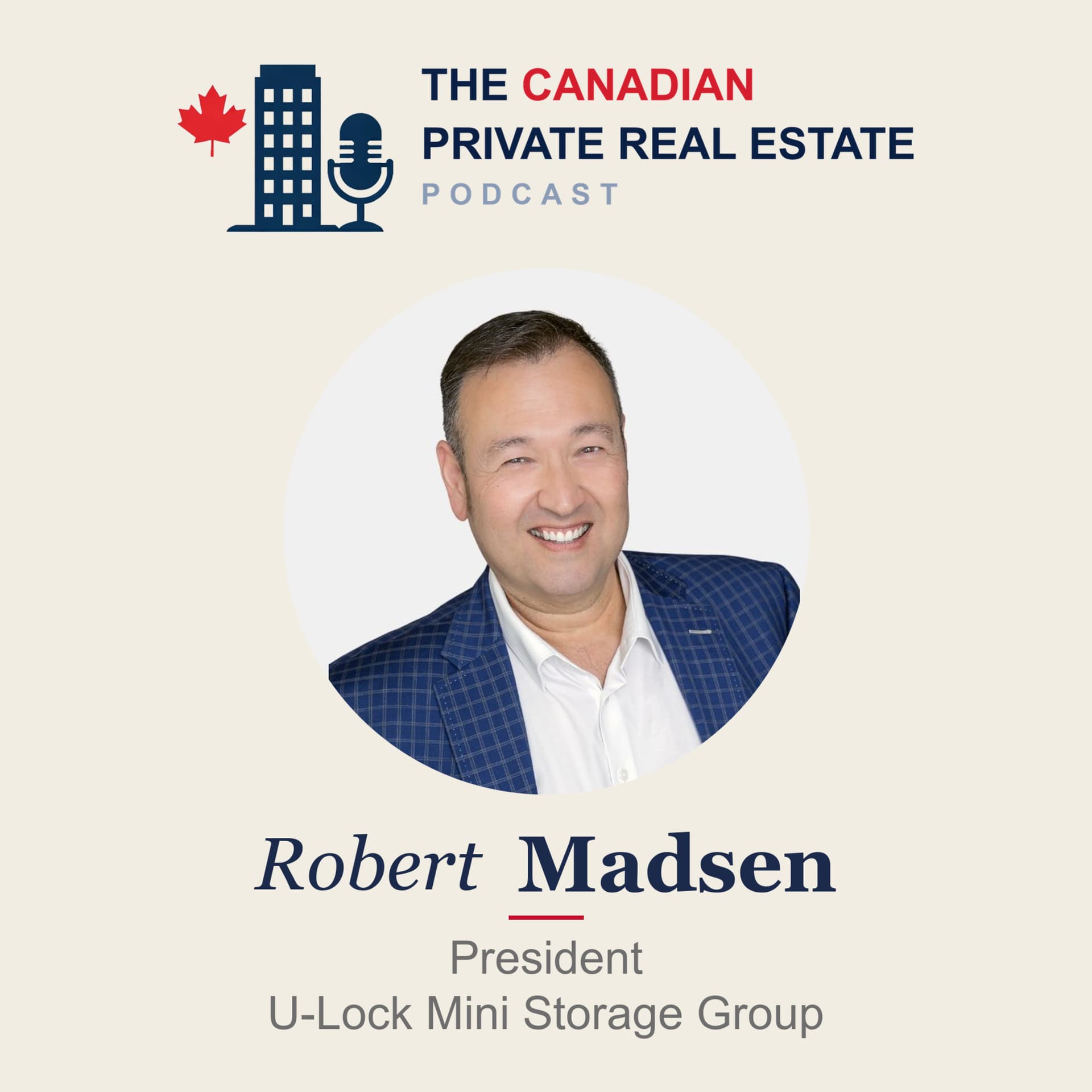
7: Investing in Self Storage, with U-Lock's Robert Madsen
Guest: Robert Madsen
EPISODE DESCRIPTION
In this episode, we're joined by Robert Madsen.
Robert is the President of both U-Lock Mini Storage and the Canadian Self Storage Association from the Greater Vancouver Area of BC, who was born into the self-storage industry and has amassed over 40 years of experience.
Regarded as pioneers of Canada's self-storage industry, the Madsen's founded their first facility of U-Lock Mini Storage in Vancouver's historic Yaletown district in 1978. Today, they own over 500,000 square feet of premium self-storage facilities serving the Lower Mainland and Vancouver Island, and continue to expand their portfolio through strategic acquisitions, development, and new product offerings.
Robert is here to discuss:
→ His journey in self-storage and why it is not a passive industry.
→ The unique benefits & risks of the self-storage asset class, including being both a real estate investment and operating business combined, and the typical rent-up timeline of 3-5 years.
→ The typical metrics for self-storage feasibility including supply and demand, renting rates, and unit mix, what factors impact customer demand, and why comps are so hard to find.
→ The typical facility size in the Lower Mainland and staffing needs.
→ Canada's current self-storage market and what makes it niche compared to the US.
→ How self-storage boosts the economy, the impacts on entrepreneurs, and the opportunity for value adds.
→ How AI has impacted the self-storage industry as a whole and Robert's business so far and where it could go in the future.
→ The biggest over and under-blown risks in the self-storage space - the next generation of consumers and that it is an actual business.
→ Two pieces of advice - never make assumptions and keep innovating.
***
🌎 U-Lock Mini Storage Website: www.selfstorage.ca
📸 U-Lock Mini Storage Instagram: @ulockministorage
🔗 Robert Madsen's LinkedIn: @RobertMadsen
***
CHAPTERS
00:00 Intro
0:26 Today's Guest: Robert Madsen
3:34 Unique Benefits to Investing in Self-Storage
5:03 Unique Risks of Self-Storage
7:07 Typical Metrics for Feasibility & the Difference of the US Market
10:22 What Factors Impact Customer Demand
12:12 The Current Canadian Self-Storage Market, Number of Facilities, & Finding Comps
16:34 The Opportunity for Value Adds
17:46 Municipalities Misguided View on Storage as an Economy Booster
19:15 How AI Has Impacted Robert's Business & the Storage Industry So Far
22:09 Typical Facility Size in the Lower Mainland & Staffing
25:02 Over/Under-Blown Risks in the Storage Space
28:27 Important Metrics - Supply/Demand, Rates, & Unit Mix
31:20 The Rent-Up Timeline (3-5 Years)
35.28 Two Pieces of Advice
36:43 Wrap-Up
***
CONNECT WITH HAWKEYE WEALTH
🌎 Hawkeye Wealth Website: www.hawkeyewealth.com
🔗 Hawkeye Wealth LinkedIn: @HawkeyeWealth
📬 Hawkeye Wealth Newsletter: @Newsletter
💰 Hawkeye Wealth Mortgage Fund Guide: @MortgageFundGuide
***
Read the full transcript
Transcripts are machine-generated and may contain errors. Please refer to the audio version for greater certainty. Generated 2026-08-22.
Introduction
Justin Smith: Hello and welcome to the Canadian Private Real Estate Podcast. Thank you for joining us. This is your host, Justin Smith. Today I'm joined by the president of U-Lock Mini Storage and president of the Canadian Self Storage Association, Robert Madsen. The Madsen family are true pioneers in self-storage in this country. I believe they opened their first facility back in 1978 in Vancouver's Yaletown, converting an old six-storey brick warehouse. And today the family owns and operates a number of U-Lock facilities across the Lower Mainland and Vancouver Island, with more than 500,000 square feet of rentable space. Robert quite literally grew up in this business — Rob, you may have been born in a 10 by 10 for all I know here. But one thing I've noticed about Robert is the energy he also devotes to advocating for the entire industry, not just his own shop. So he's a genuine steward of this space, which is quite frankly rarer than it should be. So Robert, it's great to have you here today, and thank you for joining us. How are we doing?
Robert Madsen: Yeah, Justin, thank you. Great intro. And yeah, I'm really happy to be here and just talk self-storage and any questions you have.
Growing Up in Self-Storage
Justin Smith: Sounds good. Well, can you get us started here? Can you tell us a little bit about U-Lock and the path from that first Yaletown warehouse in 1978 to where you are today, and how you came to become the head of the family business?
Robert Madsen: Absolutely. Yeah, some of my fondest childhood memories were in self-storage facilities. And so in Yaletown, when I was out of grade school — like we're literally talking grade four or five — of course my parents didn't have anywhere to put me, because they both were entrepreneurs working in the self-storage business. So I came to work. And that means I was put to work throughout the day, sweeping, cleaning out lockers, applying paint. I can only imagine as a young kid how well I did that — it might have been a little messy. But yeah, just worked in self-storage while my parents were working in the office and running the business. That kept me busy. So I literally spent a ton of time from ground level up. And as I progressed into high school and university, of course, I started working night shifts and evening shifts, which at the time — self-storage was even a little more, it's very competitive now, but back in the day it was a great place to actually do studies at night and, you know, do my university schoolwork and have a part-time job at the same time. And of course as I carried on, computers came into the industry. So I have been through all the different stages and jobs of self-storage and the modernization of self-storage. And thus, yeah, it's in my DNA and my blood and I love the business.
Not a Passive Business
Justin Smith: You learned first-hand at a very, very young age that it's not really a passive investment, is it?
Robert Madsen: No, I actually laugh. It's been misclassified really as a passive investment or passive business. And definitely the facilities we have are urban, but even when I think of the rural facilities we have, there's a tremendous amount of work. And if I went to any of my staff or team members and joked how is this passive — are you just relaxed? — like, no, they have, there's always something to do. There's people moving in, people moving out, we have to work hard on acquiring new customers. There's a lot of work to be done in self-storage, and I think that's actually one of the biggest things that gets overlooked, that it's a real business and you gotta treat it as such.
The Two-Sided Appeal: Business and Real Estate
Justin Smith: Yeah, there's a lot of work. You've obviously determined that it's worth it — or maybe some days you've determined it's not worth it, but you show up anyways. But there's obviously some unique benefits to investing in self-storage that you appreciate compared to other asset classes. Can you share a little bit what some of those unique benefits might be?
Robert Madsen: Sure. I mean, it's always a great investment because you are investing in the real estate side. And I think a lot of people outside of storage look at that fact that there is a business and a real estate side and aspect. There's almost two aspects to it that are quite great. You know, if you create a great running business, it carries the purchase of the land. And it's really nice to have those two features. I really enjoy the operational business side — there are so many different challenges that come up every day as an entrepreneur that are really fun to be a part of, lots of things to solve. Competition is pretty strong these days, so you really have to be on top of it. And I love all those components of the asset class. And at the same time, guess what? My land is being paid for through this great operating business. So it is a twofold investment. I think a lot of people don't always look at how complicated or how much work is put into it, but I actually enjoy that as an entrepreneur. I really like those features and it's a lot of fun for myself and my team. Keeps us super busy throughout each day.
The Risks Investors Underestimate
Justin Smith: I'm sure you have some war stories — maybe, maybe not traumatic enough when you were in your teenage years or younger years that it put you off from the business entirely. But I bet you've seen some stuff, Rob. Maybe that segues into our next question about what some of the unique risks of self-storage are. I think many niche players in the market — at least I've seen folks out going to try to raise capital for deals, make it sound like it's easy and maybe discount some of those risks, perhaps to the detriment of investors.
Robert Madsen: Yeah, I mean, you have to be careful. You have to remember it's a business like any other. I catch myself whenever I see another business that I'm not in, I'm very careful to recognize that that business is a real business — there was an entrepreneur in there who stayed up late, took a lot of risks, had to jump into action when emergencies occurred, and storage is no different. Storage is a very high barrier to entry, so it is expensive to buy land and to buy the assets. It doesn't work so well when you lease, so you really do want to have both components. And it is a long-term horizon too. It's not a get-in, get-out business, particularly if you're buying at market or if you're building a site. It takes years to build, to go through entitlements with the city, and then you have to rent up. And it's very hard to pre-lease storage. It's not something that is a trade of storage — so you pretty much have to rent it up as demand meets. So I see a lot of people who think it's gonna be a quick in and out, and it isn't. It really does take a full five years investment as your start. And then you really do need your second five-year investment. And I see a lot of people underestimate that investment term length to get to fruition.
Justin Smith: So total ten years from start to finish would be kind of a typical time horizon?
Robert Madsen: Yeah, if people are looking at a five-year, or if they're presented with a five-year, it's pretty tight and risky. In all those years too, guess what? Like as we know, markets change. What may have started out as a great market, over five to ten years, a lot happens. And we even look back at our last 10 years — there was COVID in the middle of it, lots of unpredictable things. So you have to be fairly agile and ready for a fairly long-term investment. You really have to watch out for overly happy feasibility studies or overly happy return projections.
Feasibility: Square Feet Per Capita
Justin Smith: What are the typical metrics used for feasibility studies? Is it like population per unit type of thing? Or what are you looking at?
Robert Madsen: Yeah, I think a lot of people look at demand per square foot of population, or supply per square foot in a region. So if you're looking at an area like Surrey or Vancouver, you're looking at the overall population, you're looking at the existing supply of self-storage into that population, and you're coming up with numbers of two square feet per person of population in that region, or five square feet per person. And like any business, it's a supply-demand business. If we build too much storage because we think the market is undersupplied, well, you're really going to have an impact on the supply side where there's too much supply — and that's what we're seeing in a lot of markets that have gained a lot of interest over the years. And now pricing has to come down to meet, because there's just so much there. It's just economics, and they have to match. I do find when people compare the US to Canada, they look at that metric and they often think, wow — in a lot of US cities you're supplying, you know, five to ten, but in Canada you're seeing a lot of three. So there must be an untapped market of demand there. And that's not the case.
US vs. Canada: Why the Metrics Differ
Justin Smith: The square foot per person, the two to five. Americans just have more stuff.
Robert Madsen: They have more stuff, but they're also different consumers. They have a military component. Americans are very transient among their twenty-seven major cities. That causes them to move from place to place. Whereas here, you're only moving to four or five cities if you actually do move, and they're very spread out.
Justin Smith: Americans move much more often than Canadians. I don't know if you have any stats off the top of your head on that, but —
Robert Madsen: Yeah, no, a hundred percent. I don't have the hard stats, but Americans, they're definitely faster on the entrepreneur activity, but they're also fast on the corporate ladder and they have a lot of choices. So all those things create a bigger velocity of change and movement, which creates demand for self-storage. We are all around just more conservative. And that means there's different metrics between the countries. So you have to be careful not to use too many US numbers to over-boost your pro forma.
Justin Smith: Right. And would you say three square feet per Canadian is sort of a stabilized number? What's your thought on that?
Robert Madsen: Yeah, I would say these days — and we have to be very careful here, 'cause each region has different drivers of demand — but often in Canada, if I saw a three to five square foot metric, it seemed to be a happy place in the market of stabilized facilities, and still a little demand left over. So it seemed to be close to equilibrium. There are some different markets out there — I've seen, for example, in Parksville, go up to nine: high retirement community, lots of stuff. And maybe that's why that market sits a little higher.
Justin Smith: Like downsizers that don't want to get rid of their stuff.
Robert Madsen: Yeah. But then you see some other markets where it's just way tighter. And maybe that's — when I think of Vancouver, it's a very expensive place, which means in BC our disposable income after tax and needs is much less. So that might change your demand of how much you're gonna pay for an additional storage locker when you're already paying a lot for your house mortgage.
Supply, Demand, and Falling Rents
Justin Smith: Right. Does lowering rents impact demand as well? I mean, if you're paying less for a property, maybe you can have that extra closet space or bedroom or something that may wane on demand. Are you seeing that?
Robert Madsen: It's funny — when I think of lowering rents, I actually think of, if you're lowering the rent of an apartment, for example, then I think people are maybe acquiring bigger space for less. So that might not necessarily drive storage. When I think of what we see on the storage market and rents, when you have oversupply, it is causing us to lower rents as an industry, because we all want that next customer, but the customer demand doesn't change a lot. Like, if there's a sale on chocolate bars, we might go load up on some chocolate bars. But if there's a sale in storage, the primary need was either there or it wasn't there already. Like, you were moving, so you needed it. That didn't change.
Justin Smith: Yeah. It's not like a house where your pool of users gets way bigger if the price comes down.
Robert Madsen: Yeah, you're not racing out to buy storage just because it's inexpensive. And so there are definitely some economics that go beyond the storage unit that drive the need. And often we actually look at, what are the demand drivers? And right now in suburbs and rural communities, housing transactions — a strong housing market does create demand for storage, because you have to temporarily move or long-term move. And of course in BC, and in different parts of Canada, we're seeing very low, inactive markets on housing transactions. That is impacting storage right now.
A Niche, Fragmented Market
Justin Smith: Sure. Well, you talk about those five-year time horizons and things can change in five years. I mean, that's been true across any of the asset classes — multifamily, industrial. Nobody would touch retail during COVID, and now grocery-anchored retail, we're back, baby. So things change a lot. If you could kind of summarize how self-storage has performed over the last four or five years here, that would be helpful.
Robert Madsen: Well, over the four or five — and I wish, you know, statistics in Canada are a little bit rough — but definitely if you go into the US stats, it's generally shown over the forty years that self-storage has been one of the strongest performing asset classes against the others. And in Canada I would say that we've been a consistently strong performer. I think the US stat generally showed fourteen percent IRR, which is fantastic. And I think Canada, being a little more conservative, isn't too far off that. So through thick and thin, COVID, economic downturns — the last five years, we've been a pretty strong performer. But we do have our ups and downs. And I find all industries, we have our ups and downs; the cycle is there. But keeping that in mind, it's a cycle, so we definitely have good times too.
If I just look at the last five years, coming through COVID was some of our highest occupancies and our highest rates. People were moving to home office, they were clearing out their garage space, and work trends were changing. A lot of people relocated too and needed different storage. So there were a lot of housing transactions and renovations demanding storage. And now I do find time has sort of normalized. All those housing transactions have slowed down. And so we're feeling that right now — it's a bit of some of the hardest market I've seen in storage. And that said, we work very hard on our competitiveness and our profitability, and we're weathering through this economic cycle that we're in. It is sad to see some of the problems that are happening in the economy and international trade. Even though we're not directly related, we indirectly feel it when people are going through some rough times. So, still a great industry. I should note, it's very niche still. We have to keep in mind that there are only so many storage facilities in the market.
Justin Smith: Yeah, what is the universe in Canada? Are we talking like three hundred, five hundred, a thousand self-storage facilities?
Robert Madsen: Yeah, across Canada there's, I don't know, twenty-five hundred to thirty-five hundred self-storage facilities — but you have to be careful, because does that include a facility that has twenty lockers? Yeah, it does. Whereas in the United States, you're pushing fifty-eight thousand plus storage facilities. And sure, there are some small ones there too, but that's a completely different factor of number.
Justin Smith: Yeah. Is it like an eighty-twenty situation where twenty percent of the facilities have eighty percent of the space? Would that hold up?
Robert Madsen: Yeah, I don't know if it's quite that ratio, but there's definitely an imbalance like that. And even if you come into Canada and you look at the largest 10 operators, they do have a lot of the bigger storage facilities in that mix. Whereas you go into the States, you see a lot of mom-and-pops who actually have very large facilities and a bigger spread. But here you definitely see a lot of the modern big facilities usually merging together or falling into one portfolio.
Justin Smith: Just to get enough scale in a smaller market. So it's probably like the same three, four, five brokers selling these things, isn't it — everybody's schmoozing trying to get listings?
Robert Madsen: You nailed it. It's super niche. The reality is there aren't actually a lot of storage operations when you hit a big city, and all the owners — there's only so many facilities. It's not like restaurants where there's thousands in a city. It's a very niche industry. And sometimes that can be a bad thing, in the sense that if you see a big sale that produces some great stats, that was just one site. It doesn't mean the whole industry is experiencing that.
Justin Smith: Makes comparables a lot more difficult, doesn't it — just fewer transactions.
Robert Madsen: Yeah, makes it super tricky. We just don't have enough transactions per day, per week, or per year, in all honesty. There was one year a few years back where BC really only had two major sales in the entire year. So it would be incorrect to take those two sales as being indicative of the entire BC market. And on the transaction too, the buyer might have only wanted that facility or that portfolio. It doesn't mean everyone has an opportunity to transact at the same numbers. So it would be wrong to just believe that that's the market.
Value-Add and How Municipalities See Storage
Justin Smith: So a big part of the strategy in multifamily or retail is the value-add component — do you renovate these properties, increase the rents, or were they generally undermanaged and is there an opportunity to add value? Maybe that's a unique benefit of the self-storage space, because it's heavier on the management side and there's more of a business component to it, therefore there's more value to be added. Would that be a roughly true statement?
Robert Madsen: Yeah, I think you do have to look at the value-add side. A lot of the facilities in a market have been around for decades. And while the facilities may be very well run and kept clean, there hasn't been a lot of value-add or improvements to the site. So there's opportunity to go in and market the site up and increase rents. Definitely if you're looking for a market that's undersupplied and you develop, there's a true value-add there. It is more difficult in some markets — like BC, land prices and construction costs are higher than other parts of Canada. So you have to be very careful. Numbers still count. Just because you can fill it doesn't mean you should do it if the costs are too high.
Justin Smith: Right. I've heard municipalities may not like it because there's not as many direct jobs created. Is that an issue?
Robert Madsen: Yeah, municipalities have an interesting outlook on self-storage. They look at a facility and they just see the physical — how many people are there in the office working. But what they don't calculate is how much economic generation that site may create in a community. So you may go to a suburb site, it has 800 lockers, and you might find that 30% of those are entrepreneurs who are growing a home-based business or a mid-sized business. They're using the lockers for inventory control, inventory efficiencies — they're running their business through that. And there are a lot of big businesses that we see today that actually have a storage locker behind them.
Justin Smith: A lot of indirect benefits to the community. That sounds like something the president of the Canadian Self Storage Association would say. But I believe it. And maybe somebody moves to that area just because there's a facility nearby.
Robert Madsen: Well yeah, entrepreneurs generate for the community. They add a lot, and guess what — they can't all go buy a big warehouse. So they'll go and rent a space, it's month to month, they can flex their inventory up and down. And there's a lot of those in a self-storage facility. And that's what helps make that entrepreneur grow their business, become more successful. We've seen lots of multinationals — guess what, they started out of some guy's garage or yard, they got a storage locker along the way, and the rest was history. It was all part of their progression in their community.
AI at U-Lock
Justin Smith: You talked about, when you were telling us a little bit about U-Lock and growing up in the business, that you were there when computers came online. And I imagine there were some people that had always done it with paper that hummed and hawed about having to now use this dumb computer. And of course, now we've got AI taking the world by storm. Is it reshaping the industry in any meaningful way yet? Is it being heavily adopted? Is it being resisted?
Robert Madsen: Hundred percent. Yeah, AI is definitely having some impact. And you have to be a little understanding, though — how big an impact does it have? If you take a site, sites can't be run a hundred percent on AI, but can we use AI to better run a site, to collaboratively analyze whether we should invest in a site? Can my team, through AI, make all their tasks better or produce better quality work? A hundred percent. And so technology is really interesting. You know, we may encounter a really great self-storage site in a market that has equilibrium, but it doesn't have a website — and maybe they don't have a computer system, and they have a really nice site with great potential.
Justin Smith: Really? No website? Do you try and buy it immediately?
Robert Madsen: Suddenly there might be a very strong value-add component there. It should be flashing up in lights, right?
Justin Smith: No doubt. Yeah, they're emailing you with the Gmail address.
Robert Madsen: Yeah. And so definitely for us, we're competing against Public Storage and SmartStop and Sentinel and all these big organizations that have a completely different amount of money to spend on technology. And one thing AI has really helped us do is compete closer to their level, or work hard to level up. It's definitely given us an extra advantage to try and stay on par with those groups. The amount of times I used AI before this call today for my different various aspects is significant. And I can tell you my team members in some of those meetings, we used AI as well. And it's a collaboration — we're using it to better analyze different models, different ideas and innovations, trying to draw what metrics are the most important and how we rate to industry. And obviously, even just on creating marketing materials and different things, it's a super powerful tool. So everyone, depending on what they do in the company, uses it collaboratively, and it's making a big difference. It's not the be-all end-all yet, but it's only been around for a few years when you really think about when ChatGPT just went live. And here we are just a few years, and the amount of change in its ability is high.
Staffing a Facility
Justin Smith: Sure. And it hasn't even been embodied yet — like the robots, no robots yet, but they're coming at some point. How many humans are on — let's say, what's a traditional size of a building? Is it two hundred? Would two hundred units be pretty typical in the Lower Mainland?
Robert Madsen: I would say in the Lower Mainland it is higher. Because in BC, the high expanse of urban land, you really do need to build a facility that's probably seventy-five thousand net rentable and maybe six hundred to eight hundred lockers inside that.
Justin Smith: Okay, so six hundred to eight hundred lockers — and how many people would be part of that business generally?
Robert Madsen: Yeah, so in the actual rental office, you're typically seeing three to five staff members there. Keeping in mind though, if you have 800 lockers and 300 of those lockers are rented to businesses, it multiplies all the business employees. And that's why it contributes to the economy. But yes, if we're just talking about the site itself, there's a number of employees working to keep the facility running, keep it clean.
Justin Smith: On site as well. So you've got the salespeople driving the leasing, and you've got on site typically at any given time — is that another two, three people? And then I imagine you have security as well.
Robert Madsen: Yeah, on site, employees, they're in that three to five. So a downtown site, which can have a lot of commercial activity in the mornings and lots of things going on — could they have all five on at once? It's possible. That's typically the high point of what they need. Could they operate with one? At certain times you could, but it's very hard. From a security standpoint, you're definitely not staying on top of everything either and providing proper service. So you wouldn't want to be in that situation for too long. And then of course, that person is a steward of a very expensive, multi-million — tens of millions of dollars — facility. So there's a lot of real estate and infrastructure there that they're looking after, and then there's the whole management of the digital footprint on the website and all the things that have to happen there. So the team, it is more intensive than most people think if they're not in the business.
Justin Smith: Yeah. So up to five generally to manage a whole facility. I'm just curious at the potential changes as those people can do other things while the robots do stuff — there's always need for people, I'm not too worried about it, but I'm just curious to hear where the efficiencies could potentially be for you.
Robert Madsen: Yeah. I mean, if you go down into the US, there are a couple models out there that are only adding one employee, for example, as they scale up, or two employees. And both those employees might not be full-time. But those are typically organizations that have a big back-office team; they've really embraced different technology to run.
Justin Smith: Right. So it's really more than one or two — it's just they've got a scale where they've got the leasing team and a head office.
Robert Madsen: Yeah. And if you're investing in the business and you need to rent up or make big changes, you're gonna need more manpower to do that. So you have to be careful not to underestimate your employee expense area. I see that happen a lot on new builds, where — no, that's just not a realistic number of team members needed to properly rent up a growing facility, particularly as you're in rent-up.
Rent-Up Timelines and Bank Risk
Justin Smith: Yeah, it actually dovetails nicely into my next question, because you've lived through a lot of downturns — families have been doing this since the seventies. I've got you quoted as saying "the only certainty is volatility." In that vein, what risks do you think self-storage investors are underestimating right now? You mentioned one is how much manpower it takes to get it leased up. And on the flip side, which risks do you think are being overblown in the industry?
Robert Madsen: Ooh, risks that are being overblown. Well, I know I'm a big proponent of AI and we just talked about AI, but you definitely don't want to think that AI and young generational growth is gonna result in no demand for storage, or a declining demand. There is a narrative in that sense.
Justin Smith: Is there a narrative out there that this is gonna happen?
Robert Madsen: Obviously there's a lot of people that are worried about AI impacting industry in the Canadian economy and reducing people's employment — and where does that go if people aren't working as much, or the job landscape changes? And there's another narrative that's been around for decades about, do today's 20 year olds, as they grow up, are they gonna have the same demand for storage as boomers? Is storage demand going to change with different generations coming up through the ranks? You never know. I mean, we are a fairly disposable society now, right? On how fast people change iPhones, or you can get a bunch of IKEA furniture and it's very inexpensive — so do you store that? It's no longer that dish-china collection or the antique furniture; people generally don't want that in their house anymore. We also are in an economy of recycling. And that's changing some of the metrics for the better, I think, in their use for storage. But that said, these concerns have been around for decades, as Gen X and different groups came up. And what we're seeing is demand for storage has actually continually grown with those groups. Because as long as those groups are moving around or creating different drivers, there's still a drive for storage. So I know there are people in the industry, or outside the industry, who view that as, this generation is not going to use storage. And data is showing that's proving not to be true. They are using storage differently, 100%. There are very key differences with different generations, but guess what — they're still turning to storage to help them in either their business or personal needs.
On the not-overblown side, I think again — I can't say it enough — it's still a business. There's still supply-demand economics that you can't ignore. I do see even today there are facilities being built where they think it's just gonna power through. And this is a great-looking site, how can people not store, there's such great population growth in the region — but the site is fully ignoring the supply-demand economics of that region. And you just shouldn't do that. Because if you ignore that or think you can power through, you're gonna find that your rent-up is really slow, just because the demand wasn't there or the market's oversupplied. And these are really expensive sites. Property taxes do not treat you well. If you are not at stabilized occupancy, the property tax doesn't adjust. So it's still significant. You need to plan accordingly for that painful period while you rent up.
Unit Mix and Rate Assumptions
Justin Smith: Right. That can take a little while — you're talking about how the time horizons can be much longer than people think. Is it mostly just the population per square foot when we talk about not understanding the supply-demand dynamics? Are there any other metrics that would be helpful for people to be aware of that could help them triangulate that demand?
Robert Madsen: I think that is the majority of it. You also have to be really cognizant of current rates in the market. And it's interesting, because of course rates are related to supply-demand. But a lot of the time, if you look at rates in the market, the rates you see may not be the rates that the entire facility base sits at. So if there's 800 lockers and you see a great high rate right now, it doesn't mean the rest of those tenants who have been there for years are paying that rate. Often they're paying grandfathered rates that haven't escalated — so they may be 25% off that rate mark. And that would be bad math if you just assumed you can get all those people at today's rate. So you have to be really cognizant of the rate you can command in a market. And right now we're in a rate decline. So we do see a lot of facilities under construction, or that have just come to market, or are coming to market to add more supply — and their business plan was on a rate plan that was done three to five years ago. And that rate plan showed escalating, increasing rates.
Justin Smith: But in multifamily, pretty typical is like a three-ish percent give or take per annum. Is it the same in the self-storage business?
Robert Madsen: I actually think people on their feasibilities were putting in more like a six to eight. And the reason why they were putting that in is because they had to, because of the sheer cost of buying the land and the cost of the property tax escalation and the cost of construction. And so you can imagine, if that shifts, if that turns, it creates a pretty big problem.
Justin Smith: God bless reverse engineering. "I need this return, therefore this is what's going to happen."
Robert Madsen: Well, and we definitely see some facilities too that have too much of a certain unit mix. I haven't even touched on that, but if you build the wrong unit mix in a market — because maybe it's driven by financials, because a smaller locker, the dollars per square foot are higher, and sometimes three to four times higher than a big locker that you could park cars in — you have to watch out for that. Because at the end of the day, it's not what you think produces the best financial outcome; it's what the market will take, what the supply-demand is. An entire market doesn't need a ton of small lockers. They need a nice mix of lockers to meet demand.
Justin Smith: That makes a lot of sense. The same is said about the multifamily space. You can build a full building full of studios and it looks great on a pro forma, but you're gonna have a lot of vacancy. I'm sure it's probably part art, part science for you to figure those unit mixes out.
Robert Madsen: Yeah, you gotta fill it. There's some rules, like any business, that you should be mindful of and not think you can defy. So: unit mix, how long it takes to rent up, supply-demand.
Justin Smith: Is there a rule of thumb for how long it takes to rent up? I've heard people say like three years, but I imagine it may not be three years if you've got a smaller facility. Is there a time-per-storage-locker metric, or what do you use?
Robert Madsen: Yeah, I mean, we typically, if we can test to a three to five year on a modern large-size storage facility, that's usually safe ground. And you know what, in COVID times, and in undersupplied markets, that facility might have filled up in one year. But you gotta keep in mind that's not the norm, that's an outlier. Likewise, if you do a massive facility that's breaking the records of size, it is going to take longer to fill that facility, unless there is some highly unusual demand driver going into that community. And so I always found that if you planned for three to five, and you planned your break-even points, your reserve cash, for three to five, you usually had enough room to come through those times quite well. The problem is, in our developments of high barrier to entry, three to five every year is very costly on reserve.
Justin Smith: It's a big range too, by the way. There's a big difference between three years and five years on how much cash that's gonna drain.
Robert Madsen: Yeah. We've had facilities go — we had one facility that we look at today and everyone looks at and says, gosh, we should have built more, that's so amazing. But it took us seven years to stabilize that site. So in retrospect it looks great, and everyone forgets about the seven years. But I can tell you, if you're in a business and you had a three to five year plan and you went seven, it's not fun times to get to that seven.
Justin Smith: No. The destination may be nice, but that's a painful journey.
Robert Madsen: And I think that's the thing too — the sheer cost of these facilities typically pushes you to go to traditional financing from a bank or credit union. And you want to make sure they're onside, because if you're planning for three but you go five, when you go to your bank and you try to explain why it's so tight, it's sort of like showing up at your most vulnerable time. Your bank is like, hey, this doesn't look good, you said three, and we're definitely not gonna loan you more money to get to five. And that's actually a critical spot that's very uncomfortable if you don't work to be more conservative on your plan.
Justin Smith: Right. And hopefully you've kept some powder dry along the way, or you've got a good stable of investors that understood the risks going in day one — that if the bank doesn't step up, there's a plan.
Robert Madsen: Yeah. And that's actually an interesting point, because of the high barrier, you usually are maxing out all your dollars early. And then you hit your three; if you're not full, you've used a lot of your powder just to get it open and get it going. And now you're at a very vulnerable moment when it's gonna be hard to convince people. The ironic part is, that might be where you sell, because you have to. Then a new organization comes in — guess what, they take it. You got all the arrows in the back. Well, hopefully not, but that would be the buying opportunity. An organization with more capital might come in, they'll carry the last two years to get to five, and guess what, they come out looking like heroes, because you carried the hard part.
Justin Smith: Smells like opportunity. The person without the website — you probably don't even have your website going yet, Robert. You're the guy without the website. You shouldered the brunt of the pain.
Robert Madsen: Yes. And now they're in a stage where they've got it stabilized, they're starting to work rates up and really run the facility correctly, because they've got a nice stable base of tenants. And so we do see that a little bit. When I compare BC to different parts of Canada or the US, there's a lot more room for error — costs are significantly lower, double digits lower, both on land and construction and acquisition at times. And so you have more powder, you have more ability to pivot in hard times, you might have reserves. So I do find that a little bit of a disadvantage on the West Coast. We're pretty maxed out, we're a very particular market. There's very few markets that look like this — you might go to Manhattan, that's a really challenging, expensive market too. So you just have to be mindful of the cost of the investment.
Closing: "Don't Assume — Go Find Out"
Justin Smith: That's very prudent advice, and I've really appreciated this conversation. Before we get going, Rob, would you share one piece of advice you received early in your career that's made an impact on your life and that you're grateful for?
Robert Madsen: Definitely. I'll share two actually. So one was: don't make assumptions, just go find out. There's no reason to assume things. There's that classic saying of, you'll make a problem out of "you" and "me."
Justin Smith: Yeah, it's a kid's show. All those kids listening to real estate podcasts — thank you.
Robert Madsen: There you go. And it's so true — you can go find out, go close off that variable. And also, just keep innovating. It's sort of that Kaizen term, where you're always improving, always taking in, always learning how to do it better and test new ideas. I remember in the industry there was a time where a lot of people didn't want to switch from yellow pages to internet and web pages, or phone book advertising. And it's like, no, embrace the change, it's okay. And here we are. And I think the same thing's happening with AI — don't run in fear, find ways to make your organization better, leverage it, put it to use, keep an open mind, learn. I was fortunate enough in different careers and this career to learn and embrace both of those. They're a hundred percent true. It definitely makes things better when you keep both of those in mind.
Justin Smith: Wonderful advice. Thank you very much, Robert. Appreciate your time today, and thank you for sharing that many decades of experience with the audience.
Robert Madsen: Yeah, my pleasure, and thank you for having me on as a guest. I really enjoyed it.
Justin Smith: Thank you for listening. As a reminder, this podcast is for informational purposes only and should not be considered legal, tax, investment, or financial advice. Any forward-looking statements are based on opinion and are not guaranteed. Hawkeye Wealth has no obligation to update them. Investing in private equity is generally considered high risk, with potential for illiquidity or a loss of capital. Most of our investments are only available to accredited investors. As such, a suitability assessment is required prior to any investment through Hawkeye Wealth.
This podcast is for informational purposes only and should not be considered legal, tax, investment, or financial advice.