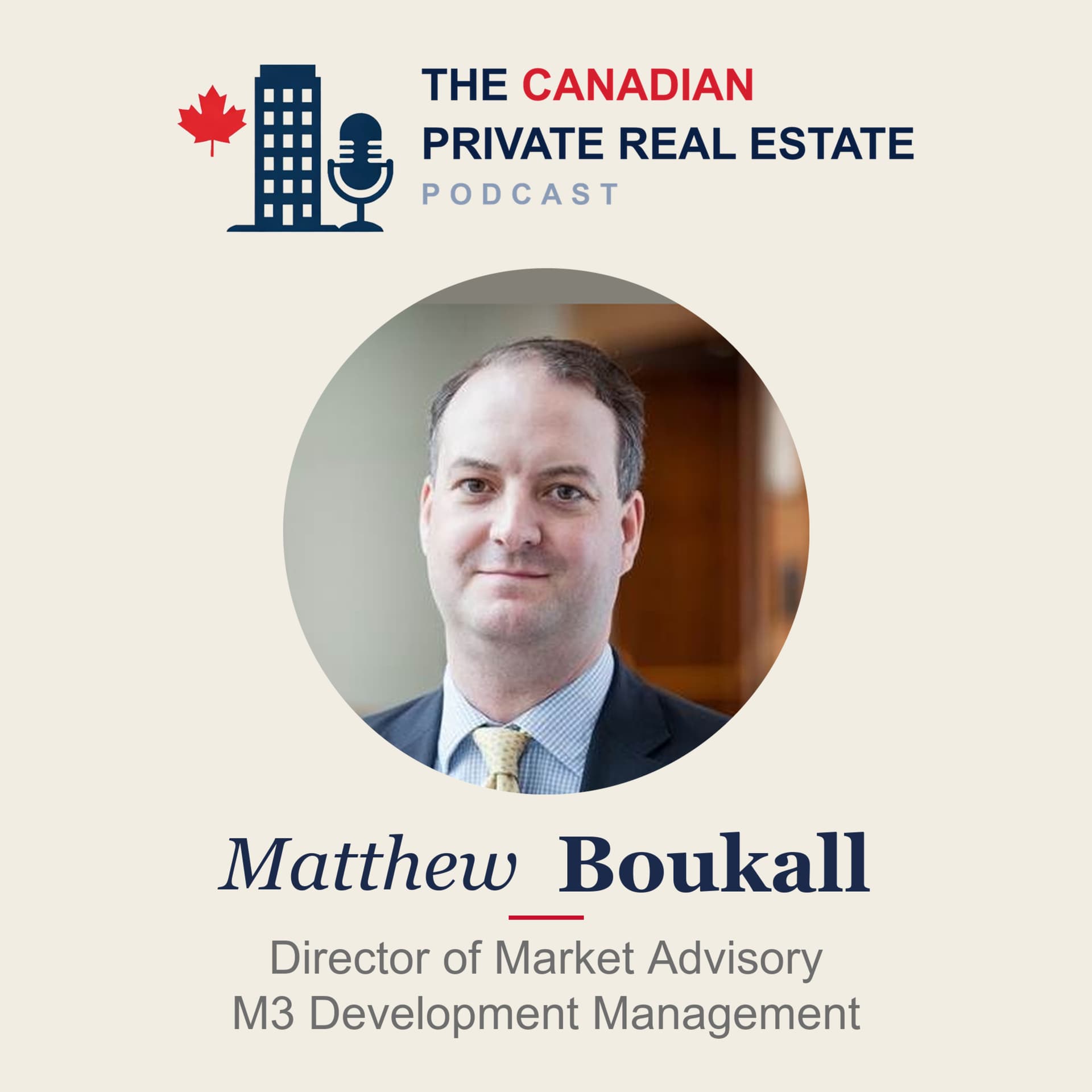
6: Why Rentals Recover Before Condos Do with M3's Matthew Boukall
Guest: Matthew Boukall
EPISODE DESCRIPTION
In this episode, we're joined by Matthew Boukall.
Matthew is the Director of Market Advisory at M3 Development Management from Calgary, Alberta, who has over 20 years of experience in real estate research, advisory, and data analytics across Canada, the US, and international markets, and is currently focused on Western Canada's multi-family and industrial markets.
A sought-after market expert and industry leader, Matthew has in-depth knowledge of real estate data, predictive analytics, and real estate strategies, providing insights that help clients identify opportunities, manage risk, and maximize value.
M3 Development Management (M3) is a Calgary-based development team made up of seasoned professionals who have gained both broad-based and specialized, international experience, collectively spanning decades within the development and construction sectors. With more than a decade of delivering excellence, M3 guides clients through every stage of real estate development from vision to execution, with an approach built on trust, precision, and results.
Matthew is here to discuss:
→ His journey in real estate, who M3 is, and what they do.
→ The current condo and rental markets in Calgary and Edmonton, including the unique factors that make Calgary the stronger condo market while Edmonton is the stronger rental market.
→ The specific factors lead to the challenges of Vancouver's condo and rental markets, their possible recovery timeline of 18 to 24 months, and if BC reducing DCCs by up to 50% will help with more housing starts.
→ An overview of Calgary, Edmonton, and Vancouver's industrial markets, why the Calgary area has had huge growth in industrial, and what makes industrial hard in Vancouver.
→ The potential impact of the newly announced Delta Port Expansion, with a capacity of up to 2,000,000 additional shipping containers arriving annually, and what that could mean for BC's lower mainland industrial.
→ What separates top developers from the rest and advice for new investors.
***
🌎 M3 Development Management Website: www.m3dm.ca
🔗 M3 Development Management LinkedIn: @M3DM
📸 M3 Development Management Instagram: @m3developmentmanagement
🔗 Matthew Boukall's LinkedIn: @MatthewBoukall
***
CHAPTERS
00:00 Intro
0:26 Today's Guest: Matthew Boukall
3:12 Calgary & Edmonton's Condo Market Shifts
6:31 Vancouver's Condo Market Challenges
9:14 The Vancouver Rental Market
10:45 When Will the Vancouver Market Turn Around?
13:26 Will BC Reducing DCCs by 50% Help with Housing Starts?
17:38 Calgary, Edmonton, & Vancouver's Industrial Markets
22:45 Vancouver's Industrial Condo Market
24:34 The Potential Impact of the Delta Port Expansion on Lower Mainland Industrial
28:12 What Separates the Top Developers from the Rest
31:02 Advice for New Investors
***
CONNECT WITH HAWKEYE WEALTH
🌎 Hawkeye Wealth Website: www.hawkeyewealth.com
🔗 Hawkeye Wealth LinkedIn: @HawkeyeWealth
📬 Hawkeye Wealth Newsletter: @Newsletter
💰 Hawkeye Wealth Mortgage Fund Guide: @MortgageFundGuide
***
Read the full transcript
Transcripts are machine-generated and may contain errors. Please refer to the audio version for greater certainty. Generated 2026-08-21.
Introduction
Justin Smith: Welcome to the Canadian Private Real Estate Podcast, hosted by Hawkeye Wealth president Justin Smith. Hawkeye Wealth is an exempt market dealer focused on finding and vetting private real estate investments for Canadian accredited investors and family offices. It is registered in BC, Alberta, Saskatchewan, Manitoba and Ontario.
This podcast is for informational purposes only and should not be considered legal, tax, investment or financial advice. Now let's get to it.
Hello and welcome to the Canadian Private Real Estate Podcast. Thank you for joining us. This is your host, Justin Smith. Today I'm joined by the Director of Market Advisory for M3 Development Management, the one and only Matthew Boukall. M3 is an advisory firm that developers hire to make sure they're doing the right things and doing things right. Matthew is Calgary-based with a focus on the Western Canadian multifamily and industrial markets. Prior to joining M3, Matthew was the VP of Product Management for Altus Group, which is where we first met. Matthew has one of those jobs where he gets to spend a lot of time thinking about where the puck is going so we can properly size things for M3 clients. So Matthew, thank you for joining us today. How are we doing?
Matthew Boukall: Good, thanks for having me. This is exciting to be chatting about the market one more time.
Justin Smith: Yeah, yeah. It's been a little while. I think back in 2019 or 2020 was the last time we had you come and present to our group here in Vancouver. So it was well received then and I look forward to hearing your thoughts right now. But to get us started, can you tell us a little bit about M3, your role as the Director of Market Advisory, as well as just give us a bit of a sense of the career path that got you there?
About M3 and Matthew Boukall's Role
Matthew Boukall: Sure. So M3 Development Management, a Western Canadian based project management, owner's rep, market advisory and cost consulting company. So, you know, we cover pretty much all the bases with respect to development and construction. We're based in Calgary, but we have offices across Western Canada — Edmonton, Victoria, Vancouver, even an office in Canmore. And we typically get involved in, you know, a wide range of projects. But kind of, I would say our sweet spot is working with the investors or developers who need support to get their project, you know, through to finish. So that could be support on the early end like you're talking about, advisory, figuring out what to do with a development or figure out the best strategy; cost planning where we're helping to estimate what will the actual cost to build be. We provide lender services, the loan monitoring and kind of progress. And then we wrap it all around owner's rep and project management where we basically help projects achieve success in the construction phase of the project.
Justin Smith: And how you ended up there — I actually saw you had a brief stint in sales, but the rest of your career arc was in research and analysis if I'm reading your LinkedIn profile correctly.
Matthew Boukall: I feel old the longer I look at my LinkedIn profile. But you know, I've been doing advisory, research, analytics and data in real estate, you know, for over 20 years. I spent, you know — where we first met — spent a number of years at Altus Group, both on the advisory side and in the product management, data analytics space. You know, left Altus Group and joined M3 about a year and a half ago and have basically been — you know, my role here as Director of Market Advisory is to help build up an advisory practice, and I mean ultimately it's just to help our clients make smarter decisions.
Justin Smith: Yes, sir. No, the developers come to you for good information and that's good, to get it straight from you, to get a sense into what you're seeing. Can you give us a little bit of a state of the nation on the condos and townhouse market in the markets that you cover? I believe it's Calgary, Edmonton, Vancouver — a little bit of a high-level overview of what you're seeing out there would be appreciated.
Condo and Townhouse Markets: Calgary, Edmonton, Vancouver
Matthew Boukall: Yeah. So the condo market, you know, across the country is having some challenges during this kind of post-changes to the migration rules, the international migration being off the pace; we're seeing less end-buyer activity. So we're seeing, you know, much kind of weaker activity. But I will say the one thing in the condo market and more so the townhouse market is it's not the same in every market across the country. We often hear that the housing market is down, but it, you know, was down for a multitude of reasons and not all of them are necessarily the same across different markets.
So if you look — I'm going to start where I'm based, in Calgary — condo sales had a fantastic couple of years with population growth running up, with investor activity, especially investor activity driving huge volumes of sales. We had record condo sales back in '22/'23/'24 and just come off the pace now in Calgary. I would say the condo market is down, but if you look at the product that is selling, it's really focused on that end-user, empty-nester, downsizer. We're still seeing bright spots where projects are continuing to sell. Pre-sales, if you can believe it in Alberta, are still happening. Investors — the other investors are owner-occupiers. So we're seeing, you know, kind of more traditional, I'd say, buyers going back ten or fifteen years, consumers who want to buy into a low-maintenance lifestyle. They are going to leverage the equity in their house and they're willing to spend, you know, in our market, a reasonable amount of dollars to get a place that works for them. So, you know, we're still seeing some investor activity. It's not like it's gone completely in Calgary, but condo volumes are down from where they, you know, where they were out of the peak. But there are still bright spots, you know, happening in the condo market here.
You know, the Edmonton market — condos haven't been around for a long time and it still continues to be very, very weak. And that's just a function, you know, of Edmonton investor demand having driven a lot of the activity for a while. The rental supply has really increased in that market and to a degree it's replaced the investor condos. Now we're seeing more investor activity on infill housing on, you know, small apartment buildings, even larger apartment buildings where, you know, the traditional investor who's buying one or two-bedroom condos, renting them, are now getting into, you know, infill housing or a little bit higher density rental housing. You know, there isn't much of a condo market in the Edmonton market. It exists in pockets, but it is definitely weaker in the most recent years.
Justin Smith: Is that mainly due to the affordability of the single-family homes in Edmonton? You know, if it's not that much more expensive to get something detached, why buy a condo?
Matthew Boukall: It's affordability. I think it also plays into the condo fees, where if you are at the lower income side of the equation, if you're buying a condo for affordability, you can probably find a better quality rental unit at a lower monthly cost than a condo with mortgage and condo fees. So if you're looking for an affordable place to live, the rental market has cheaper options for you. Edmonton has built a lot of rental product, which I know we're going to talk about here in a second, but the affordability of, you know, relatively good quality housing is very strong in Edmonton.
Justin Smith: So we are going to get into the rental, but before we get into the rental market in each of these markets here, do you have any good news for anyone anywhere about the Vancouver condo market?
Matthew Boukall: Unfortunately no.
Justin Smith: How do you advise your clients on this, Matthew? If someone comes and says, hey, I was thinking about doing this condo in Vancouver, and Matthew's like, no, no, just don't do it. What does that conversation look like?
The Vancouver Condo Correction
Matthew Boukall: We don't hear that conversation much. I mean, today it's mostly "I had a condo site or have a site and I want to understand rental or what the rental opportunities are." You know, the condo market in Vancouver kind of hit a perfect storm to a degree, where the condo market was elevated. We saw a whole bunch of starts. We saw a whole bunch of construction activity, a lot of investor activity. Pricing obviously rose with costs and that product is being delivered today. It's still being delivered and it's being delivered into a market where the investor may not want to take occupancy. So there may be some closing risks. You know, it's a weaker rental market just given how much supply is coming in and how the demand has really been pulled out of the market with lower immigration rates and certainly lower temporary residents and international migrants. It is a tough market.
Vancouver for a lot of people has just always been a strong condo market and to a degree it has, but it's gone through pain before — the post-Olympic kind of hangover where there was a lot of product, there wasn't much demand, pricing was dropping, pre-sales were, you know, very, very challenged. It went on, you know, for a little while until kind of pricing came down to the point where investors said, hey, this makes sense. Homeowners, buyers said, hey, this makes sense, and the market came back in a big way. So it's kind of pretty much a B-shaped correction. You know, unfortunately, I think this correction is going to go on for a little bit longer with the additional, you know, rental supply creating more competition and kind of sucking out that demand for investors. But I do see — and I don't hear this a lot, I don't want to say I'm bullish on the Vancouver market, but you know, Vancouver still has plenty of opportunity. It needs to work through some inventory challenges. It needs to work through certainly cost challenges to get condo product back into the realm of affordability for end users and, you know, certainly first-time home buyers. But the demand will come back.
The thing in Vancouver is the condo projects, actually all projects, got bigger and bigger and more complex. Some of the improvement is likely going to come as developers get back into basics. So getting into, you know, smaller, more affordable towers — and not more affordable on a per-door basis, but just to finance and build a little bit more basic finishes, maybe fewer amenities in the condo to reduce the cost, but also getting down into lower-cost build forms like wood frame.
Justin Smith: Yeah, yeah, a little less of this, you know, twenty-five hundred, three grand a foot downtown.
Matthew Boukall: Yeah, you're probably right there.
The Rental Market Across the Three Cities
Justin Smith: Can you give us a little bit of a sense as well on the rent? You've gone through the condo markets here. Your thoughts on the rental market? You kind of went into it a little bit here, but for all three markets, Calgary, Edmonton, Vancouver.
Matthew Boukall: Some of the rental market is kind of in flux in all three markets, but you know, different forces again at play. The Vancouver rental market: rents are coming down, supply is going up, vacancy is going up. And one thing whenever we talk about Vancouver, I always struggle coming out of Calgary is, you know, vacancy going from zero to 3% is shocking to the market. But in context to the rest of the country, 3% vacancy is still incredibly low. So your vacancy is elevated. There is a lot of supply in the pipeline and some of that supply is coming — we talked about the condo weakness, projects slipping over into rental. The private supply from the ex-condos is also hitting the market at the same time. As a tenant or as a renter, it's a pretty good time to be renting in Vancouver. You're not fighting 0% vacancy or, you know, less than 1% vacancy. You're not fighting, you know, higher rents. There's incentives. As a developer, obviously that's kind of less exciting. I mean, you want to be seeing rents appreciating.
I think the rental market is going to be a good bellwether for the condo market. And when we start to see the rental market turn with more stability, higher demand, more pre-leasing and less incentives, that to me is kind of a good indicator of, you know, 12 to 18 months' turn of when the condo market will probably see improvement.
Justin Smith: Vancouver, both condo and rental, is a supply issue more than, say, demand. Yeah. Do you have your best guess as to when that might happen? Because you were talking about how these developers are coming to you with their sites that were originally planned to be condos and now they're trying to make them work as rentals. And maybe the numbers don't look good, but they look, you know, better than any alternative. Or maybe they just have to go because they've got some debt on the land and they just, you know, they feel like the show must go on, have to move things forward, keep people employed. Do you think that prolongs this downturn in rents? Like I've seen different estimates out there. Is it late 27? Is it 28? Is it 29? Like what's your sense of when we might see the residential market stabilize and, you know, start to get those, you know, inflation-sized rent growth?
When Do Rents Stabilize?
Matthew Boukall: So there's a couple of factors in Vancouver that I'm watching. We're dealing with lag data. Number one is this population growth. So right now, you know, the Vancouver CMA for the year, the estimate is, you know, flat population. So basically as many people left as came into the market — we're not seeing that continual kind of 2 to 3% population growth, it's flat. A big driver and a big reason for that, and it's across all markets, is that temporary residents — the number of accepted new permits and visas — is much lower. So we're seeing fewer immigrants, we're seeing permits expire and populations leave. That kind of mismatch is probably going to go on for another 18 and 24 months and that's kind of where we started. You know, when the permit quotas first changed, was about two years ago, you know, a two-, three-, four-year permit, those expire, those populations leave and we finally get back into a slightly more balanced situation. So on the population side, you know, the international migrant and the temporary resident, the student visa, any changes to the quotas would be a positive thing for Vancouver where we could start to see more students coming to the market. But I think we're still 18 to 24 months away from that.
The out-migration out of the Vancouver region to other parts of Canada and to other provinces for work has been a concern, and that trend was happening before the current downturn we saw. Just generally, I wouldn't call it an exodus, but people leaving Vancouver because of housing affordability or for better opportunities. And some of the early data suggests that it is starting to slow, but the improved housing affordability in Vancouver should start to keep more people in the Vancouver market, particularly when immigration picks up perhaps.
And then, you know, the final thing is just the number of condo units under construction being delivered, and that's going to start to fall off here with the lack of kind of new construction. So we're going to see much fewer new construction coming through. We're going to see product being delivered and then the inventory gets into balance. You know, all three of those should start to see some improvement in late '27, but you're probably going to see more stability coming in '28.
BC's Development Cost Charge Cut
Justin Smith: When you are looking at that late '27 time horizon, is that taking into account what the impact you believe will be from this new BC government program? They're trying to reduce the development charges drastically by up to 50%. Do you forecast that's going to increase new starts in a material enough way to lose a lot of confidence in that 2027 forecast, or do you think you've done a pretty decent job of trying to factor that in?
Matthew Boukall: It's good, it'll have an impact, but I think the impact is going to miss kind of the trajectory in terms of starts. There's going to be a period, it'll probably be slightly more compressed now than it would have been before, but start activity is not going to pick up immediately because of that incentive. Even if we do see more construction in the short term, coming off of that, construction takes a long time. It's not that you can deliver in the next, you know, 12 months based on the fact that this new incentive came through. So I still think — which is what the market actually needs — we are going to see contraction in deliveries after kind of '27 as most of the condo product in the pipeline gets built. The rental increase is not necessarily going to replace that on a one-to-one basis. So we'll just need less product being delivered outside of 2028 and that's going to actually help support rents, and kind of ideally population growth is occurring at the same time and we may see some recovery in rents on the upward.
Justin Smith: So your sense is that the new program will improve the math, but not dramatically enough to see a more immediate goal?
Matthew Boukall: It will improve the math, but it's not going to make the math so compelling that we will see stalled developments or projects on the fence suddenly decide to go full bore. I think they will build over time.
Justin Smith: So when the developers are coming to you with their condo project, "let's go rental now on this 50%," and Matthew says hold up, it's not that good.
Matthew Boukall: Not that good. I think it certainly makes the numbers better, but proformas are always challenged. Even in a good market, you know, good market, revenue is going up, costs tend to follow pretty quickly. Right now, you know, costs have come down and they're going to continue to come down a bit, but they can only go so far. And we're also running into inflationary pressures on the cost side.
Rising Costs and Tariffs
Justin Smith: Inflationary pressures on the cost side here. The narrative out there has been that the costs are coming down. This isn't what you're seeing?
Matthew Boukall: I mean, the costs are coming down, but when you look at some of the global trade issues, energy prices, there's some inflationary pressures coming from external to the market that is going to drive pricing higher tomorrow. But your ability to slash pricing is limited by, you know, if you're a contractor, a trade, you still got to put food on the table. You still have to pay your bills. If, you know, commodity prices are coming in, if energy pricing, oil, gas prices just to drive your truck double month over month, your ability to keep your pricing low becomes challenged. It's kind of topical, but now we've got, you know, talk of 50% tariffs, you know, on certain Canadian goods going to the US, that could create, you know, higher cost for commodities here, could create other pressures.
Justin Smith: Yeah, if they go through, it's such a crapshoot trying to guess.
Matthew Boukall: And you know, generally speaking, costs always go up over time. So even though we're in a market that is seeing some correction, inflationary pressures on commodities will start to make costs more challenged.
Justin Smith: Yeah. And off the top of my head, I don't know what the inflation was on development charges over the past ten, twenty years, but you're dropping it by 50%. You know, it sounds nice, but —
Matthew Boukall: Not to make myself sound overly negative here, you know, certainly the 50% cut in development charges is going to help. It's going to make some projects that didn't pencil, pencil. Getting a project to approval, getting a shovel in the ground is not something that happens in a weekend. So your announcement is made, you gotta redo your proforma, you gotta double-check your numbers. You got to go back to your trades, you got to go back to your bank or your lenders, your financiers, and just make sure everything is, you know, in line. And that takes time.
Justin Smith: Yeah, there's enough of a lag here that you still feel pretty good that sometime '27, '28, especially if we get immigration back to, you know, a typical Canadian level, that we should be much more balanced.
Matthew Boukall: And you know, like I said when I started, to me it's population, we need more demand in the market which is going to come from population growth and more of the population staying in Vancouver, and that's going to give the market the confidence to go ahead and build more.
Industrial: Leasing Across Calgary, Edmonton, Vancouver
Justin Smith: Moving on to the industrial side, similar to what you did for residential, can you give us your view? We'll start with the leasing market and then we'll move into the strata market, but on the leasing market in Calgary, Edmonton, Vancouver.
Matthew Boukall: Industrial as an asset class has been the bright spot for a number of years in most areas. And you know, talk about Calgary — Calgary's seeing tremendous growth in the industrial supply, warehouse, distribution, manufacturing spaces. It's been huge growth, kind of similar to what we just talked about in, you know, the supply challenges of Vancouver. In some markets we did get ahead of our skis on supply, we were building necessarily more than the market could support, and for a period a couple years ago this is true in Vancouver, Edmonton and Calgary, kind of the shine came off the industrial market. We saw leasing activity kind of pull back and vacancy increase as that supply was delivered. I think, you know, starting in Calgary, a lot of the growth has shifted outside of the city, Calgary proper, into Rocky View County, which has, you know, advantageous kind of tax structure and readily available land supply. That market has been attracting, probably to a degree at Vancouver's loss, but it's been attracting distribution. Your land costs are lower here, our build costs are lower, rents are lower. So it's a cheaper place to operate. And if you're bringing your product in off the train, put on the train, ship it out here, kind of organize and distribute it, we see strength.
I think there was a period kind of late '24, early '25 when the industrial markets here in Calgary, leasing demand was off. There was an increase in sublet space. A lot of that space was actually from tenants who were leaving Calgary and going to Balzac, freeing up a fair bit of sublet space. But the market has actually come back and we're seeing pre-leasing activity coming in. You know, we're seeing new construction that is pre-leased occurring and the vacancy has come down, availability has come down. I wouldn't say we're back into the market — you know, here in Alberta the way we were back in '22, '23 where there's rapid construction and kind of a lot of demand, but the leasing market has improved.
Justin Smith: Is it across all of the different bay sizes?
Matthew Boukall: Vacancy, availability is down. You know, large bays are where we're seeing much more of the pre-leasing activity because that's being, you know, tenant-driven where they have requirements for a certain amount of space. Small bay industrial, you know, we're not seeing as much product. We'll talk about strata here, which is more than the small bay space, but even small bay leasing, there are relatively few small bays available for lease. A lot of the supply on the smaller, medium-sized bays tends to be available in older buildings, some of which are dysfunctional, obsolete. There is still probably more demand for small bay lease than there is availability.
Justin Smith: So relative to Vancouver on the small bay side, would you say you're a much stronger market in Calgary?
Matthew Boukall: There's less of it. So Vancouver has more small bay industrial product, more condominium, condo industrial spaces than Calgary. I think it also speaks to kind of the evolution that we're seeing in the Alberta economy. You know, for years it was dominated by oil and gas, you know, Edmonton oil and gas servicing. We are seeing more small businesses open up. We're seeing more entrepreneurial activity happening as our economy has kind of diversified away from oil, gas — or, you know, the oil and gas market hasn't been as dominant — and that's starting to drive some of the demand behaviors. So small businesses, flex industrial, small warehouse space, you know, retail-front small offices, that has been, you know, a fairly strong market and we've even seen some releasing in the city of Calgary proper for small bay industrial doing reasonably well. Some infill, call it infill redevelopment of older industrial spaces into new small-bay spaces.
Seeing the same thing in Edmonton. Edmonton is still more dominated by the energy sector, oil and gas. Edmonton is a tough market to attract sometimes just because there's so much activity going on everywhere. Generally speaking, you know, the recent spike in oil and gas pricing is likely going to spur more industrial space in the short term, you know, assuming it sustains itself. But the industrial markets in Edmonton didn't go through the same boom that we saw in Calgary in terms of new space construction, but it stayed pretty static. Vacancy rates are coming down, availability rates are coming down, absorption is obviously going up, and some of the vacant spaces that were in the market are starting to get picked up, and there isn't much space under construction, but we're probably getting back into a market that may start to support more new construction just with the overall availability getting in Edmonton back, you know, closer to 4%.
Justin Smith: Yeah, yeah. And Vancouver softer than the other two?
Matthew Boukall: Softer than the other two, but for, I would argue, you know, different reasons. You know, firstly it's just land cost in Vancouver. It's more expensive, lease space is more expensive. You know, average rents are almost double in the Vancouver market than they are, you know, relative to a mature Calgary. I think the drop in international migration is impacting some of the industrial markets in Richmond, or some of those markets that were a little bit more influenced by that. There have been some larger leases that have been taken down. So you know, the one thing that Vancouver lacks that Calgary has in spades and Edmonton is just large-format industrial spaces with available inventory. So the Vancouver vacancy went up, you know, kind of in '25, late '24 as space was given back to the market and you had negative absorption. But it has started to improve as we start to take some of that space down.
Industrial Strata
Justin Smith: And so similar to the residential, you talked a little bit about the rental market leading the condo market, like once the rents start coming up again, you know, maybe 12, 18 — I don't mean to put words in your mouth, but if I recall what you were saying, you expected the rentals to turn around before the condo market. Would you say the strata market for industrial, that it's going to be — I know a lot of our listeners are in Vancouver looking at a strata market that is, I hate using the word dead, but you know, it's kind of appropriate for what the strata market is right now.
Matthew Boukall: The condo market, especially for industrial, your markets can be influenced by your businesses. So just business success — are they expanding their space, do they need more space — for the small business owners who want to buy and manage their own space, and just the investors who want to lease. You're influenced by the overall market availability. So you know, availability in Vancouver hit multi-year highs. We had a whole year of negative absorption and, you know, some challenges in there. You had the big warehouse space come into the market, Richmond, which was, you know, a massive block of available space. You saw more product delivered right at the same time as you saw demand kind of come off. The good news in Vancouver is that there isn't much speculative space under construction right now. So most of the space that is under construction is, you know, design-build for a specific tenant or has already released — you know, that product means you're not going to see a shift or an increase in vacancy and supply as that product's delivered. But yeah, you're going to want to see some tightening first. You're going to want to see demand growth, which looks like it's starting to build again. As that demand growth picks up the vacant supply, the available supply, eventually you get into the conditions where, you know, industrial condos become in demand. Just if you have more certainty around your ability to lease it, or if you're a, you know, business looking to buy a space, if you have more concern that your rents are going to grow in the lease market, you know, the conditions become a little bit stronger in the condo space.
The Deltaport Expansion
Justin Smith: One piece of news that sort of got overshadowed by the BC announcement to reduce development charges was the Deltaport expansion here. It's been on — I can't remember the name of the list — but the prioritized projects list for the federal government is this port, which is forecast to bring in more than two million additional containers per year. If that moves through, what type of impact do you think this could have for the industrial in the Lower Mainland, and when do you expect to start seeing that? I think the terminal was scheduled to be completed in the early twenty-thirties if I'm not mistaken.
Matthew Boukall: So I mean, to your first question, what impact will it have — it will definitely have a positive impact. Port capacity in Vancouver has been a challenge for, I mentioned this, twenty years — I think they were talking about port capacity twenty years ago. It's been a challenge as part of the reason we've seen that industrial growth in Calgary. So you know, an expansion of that size is going to have a positive impact. The location is also probably going to have a bigger impact across a wider area of the Vancouver market. So, you know, instead of just expanding the port in downtown Vancouver, you know, the Deltaport opens up — you know, certainly it's a benefit to Richmond, a benefit to Delta, would likely drive more demand, will drive more demand for large bay industrial spaces, distribution and warehousing space, but also be a beneficiary to condo industrial space as investors go in and their business is located closer to the port itself. The challenge is that, you know, a project of that size is going to take 5-plus years, you know, to be completed. There's contracts that need to be signed with shippers to start bringing product in. You know, there's a number of steps that is going to take some time. But, you know, overall, I think that's a huge boon for the Vancouver industrial market.
Justin Smith: Do you think that investors will get ahead of it and start pushing up land prices in anticipation?
Matthew Boukall: Where the market's at today, I'd be surprised if we saw a sharp increase in land sales in the short term just because the project is multiple years out, you know, sitting as a burden here on the balance sheet.
Justin Smith: There's also the talk of a pipeline and an oil terminal. Do you believe this is going to happen, Matthew?
Matthew Boukall: I would give it a better shot today than, you know, 2-3 years ago.
Justin Smith: I'll take it.
Matthew Boukall: I think it's a good national project to expand the ports. There's obviously going to be a lot of opposition to the oil pipeline; the container terminal probably, you know, much less opposition to that. But it should drive land pricing. Kind of my hope is that speculative activity doesn't make it, you know, challenging to develop and create some other challenges. We talked about this earlier, land pricing in Vancouver is a major issue for the industrial sector. There's just cheaper land elsewhere, and honestly, if land pricing got out of control or, you know, speculative activity took away land from development potential, you'll probably see a continuation of product being shipped by train into Alberta and dealt with here as kind of more of an inland port.
Justin Smith: Yeah. I'm really curious to hear what the impacts of, and call it that, nationalized or more local supply chains as well — as time goes on, do we end up producing more here locally and does that impact port activity? Something I've been kind of curious about — the robots can produce stuff in China, but they can also produce it in Canada and for much cheaper than we currently produce it. So I'm curious to hear how this all plays out for industrial here locally.
Matthew Boukall: I mean, it's a good news story. Port capacity has been a challenge. It's just a challenge for Vancouver, I'd say. You know, major shippers, distribution across Western Canada has been a major challenge. To your comment about is it going to be more manufacturing — you know, certainly more space, more product being shipped here is going to impact it. But I think the tariffs and this whole world reorder that seems to be happening in terms of how trade is occurring is going to have, you know, impacts. Yeah, perhaps more local manufacturing as time goes on.
What Separates Top-Tier Developers
Justin Smith: Yeah, you get to look under the hood as well. You get to see how different developers think, how they operate. A bit more of a broad question for you, but what do you believe are the most important attributes that separate the top-tier developers from the rest of the pack? Because I know we have a lot of investors that are trying to get a sense of what developer might be worth placing capital with versus not.
Matthew Boukall: Good question, because ultimately a good developer is someone who can, you know, bring a vision to a site, execute on the vision and deliver a return for their investors, but also, you know, depending if it's condo or industrial, deliver a space that actually creates value. You know, one of the things we've seen over the last couple of years — you know, being a developer is never easy, and in the current market, and I'll even, you know, bring Alberta in, which is a slightly rosier market than BC, it's still a challenging market and there's lots of risks out there. But what I think you see the good developers do, and the successful projects that come from those developers, is put a focus not just, you know, on the dollar or on the per-square-foot price or on the return or the margin. They deliver projects that create value for the community itself. You know, that could be through better architecture, design, through livable spaces, through community improvements, mixed-use, if you're talking condo, you know, creating places that people want to be. It's easier to build a boring box that delivers a higher return, cut corners and just get a project built, or sell a vision and a promise that is impossible to actually deliver, or it's cheap. So it's often easier to do that. But how you build a place and create value in a community that leaves a positive mark on the community is something that, you know, highlights a good developer. And I think in the current market, the developers that stand out are those that are able to continue to sell condos because the condo quality and the lifestyle and the vision is actually matched.
Justin Smith: Yeah. Yeah, they're really able to put themselves into the end user's shoes.
Matthew Boukall: I think you're seeing even today, like, you know, there still are condo sales happening in Vancouver. They're happening in projects where the value is there. There are buildings that are fully occupied and have stable leases and it's communities that people want to be in and stay in. You know, as an investor, if I was looking to put money in the market, I'd be looking for developers with a track record of, you know, creating community and following through with the promise that their marketing dollars are spent on earlier on to sell, and ultimately that care about the community and the neighborhood that they're building in.
Justin Smith: A proforma is not a community. That's what I'm hearing.
Matthew Boukall: I work with a bunch of cost consultants and project managers that are knee-deep in proformas all day long. A proforma is just a road map that shows you what you're going to do and how you're going to get there. It doesn't make a project livable.
Justin Smith: No, I really like that perspective. Thank you very much for sharing that.
Closing Advice
Justin Smith: To close this off, I like to ask this to every guest. Can you share one piece of advice you received early in your real estate investment career that's made an impact on your life and you're grateful for?
Matthew Boukall: Number one is, you know, for the investments that I've made, make sure you want to live where you buy, because you know, sometimes you may actually be having to live there. But if you're buying something just purely on paper or based on promise of return, doesn't have any value for you, it's probably not a good investment. Real estate is one of those odd asset classes that you can actually touch, feel, you know, occupy. And if you're buying something just purely based on the dollars or, like we talked about, the proforma makes sense, you know, you can make a good return and it can look promising, but often, you know, at least from my perspective, I was told, you know, make sure you actually see the value that you think you're going to create in the community.
You know, the other thing with real estate, and this is advice everyone has, it's a long game. If you're looking for a quick return, if you're looking for immediate, you know, gratification, you know, sometimes it happens in real estate, but it's a long play. And, you know, look at some of the projects that I've been involved with or, you know, developers I've worked with and the value that they created, you know, builds over time and it allows them to go back and do another project. You know, real estate is not something that I think should be traded on Facebook Marketplace, or investment strategies on Facebook Marketplace. I think it's something that needs serious thought and kind of ensuring that the thing you're investing in — yeah, the asset or market or building — aligns with your values, what you're trying to achieve.
Justin Smith: Love it. You know, it's funny, you know, being a long game, the illiquidity is both a bug and a feature. Depends on the year and depends what you're trying to do.
Matthew Boukall: No doubt.
Justin Smith: Well, thank you very much, Matthew. Really appreciate you coming on and sharing your thoughts, and hopefully we can have you again before too long.
Matthew Boukall: I appreciate it. Thanks for the time. Alright, take care.
Justin Smith: Thank you for listening. As a reminder, this podcast is for informational purposes only and should not be considered legal, tax, investment or financial advice. Any forward-looking statements are based on opinion and are not guaranteed. Hawkeye Wealth has no obligation to update them. Investing in private equity is generally considered high risk with potential for illiquidity or a loss of capital. Most of our investments are only available to accredited investors. As such, a suitability assessment is required prior to any investment through Hawkeye Wealth.
This podcast is for informational purposes only and should not be considered legal, tax, investment, or financial advice.