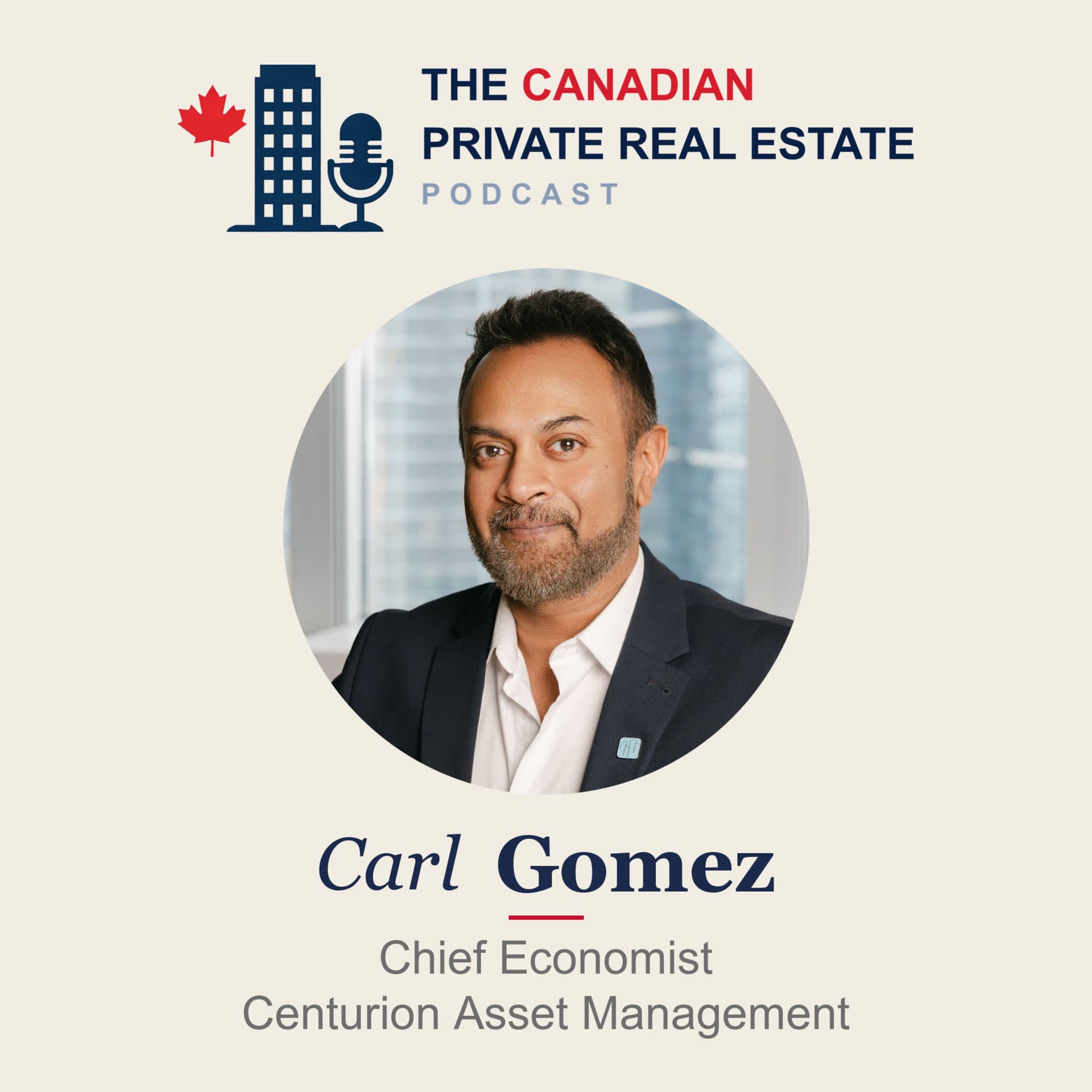
5: Multifamily, Cap Rates, and the Setup for Post-2027 Rent Growth with Centurion Chief Economist Carl Gomez
Guest: Carl Gomez
EPISODE DESCRIPTION
In this episode, we're joined by Carl Gomez.
Carl is the Chief Economist & Executive Vice President of Research at Centurion Asset Management from the Greater Toronto Area in Ontario, who has over 25 years of experience as a Canadian economist and investment professional, specializing in real estate and capital markets.
Carl began his career at the Canada Mortgage and Housing Corporation (CMHC) before working as a Senior Economist at both RBC Financial Group and TD Bank Financial Group. His career includes senior positions at Bentall Capital, Bentall Kennedy, QuadReal Property Group, and the CoStar Group before joining Centurion in January of 2026.
Centurion Asset Management Inc. is a Canadian asset management company specializing in real estate and other alternative investments. A recognized leader in the space since 2003, Centurion is Canada's largest private REIT, managing over $8 billion in assets.
Carl is here to discuss:
→ His career so far, who Centurion is and how he joined them, and what he does in his day-to-day including working with teams, deal vetting, & road shows.
→ If Canada is in a recession, future expectations for the Canadian economy, including GDP and job growth, and the differences between structural and cyclical issues and their impacts.
→ If we will have a deal with the US soon and AI's potential impact on real estate.
→ What the data is saying about multifamily and the areas in which he's pessimistic, like how we've been building the wrong housing type, and the areas in which he's optimistic, like rent growth being strong in markets where there isn't over-supply.
→ The data set real estate investors should actually be watching, long-term bond yields, because they are the true indicator of capital costs as policy rate decisions by central banks world wide have lagged behind for years, and how they impact interest rates.
→ Why the Bank of Canada will be raising interest rates in the near future and how they have been mismanaged since the start of the Covid pandemic.
→ What is happening with current cap rates for class A multifamily, why long-term institutional and private investors are currently benefitting the most, and what factors could lead to positive rent growth post-2027.
→ Debunking the myth of Canada having a housing supply problem, when it is really an affordability problem.
→ Canada's immigration rebalancing strategy, which is currently in a system correction, with the negative population growth due to exiting non-permanent residents in 2026, that will turn into 1.5% population growth with a rebalanced system post-2027.
→ The most impactful advice he received early on - trust is the essence of investment.
🌎 Centurion Asset Management Website: www.centurion.ca
🔗 Centurion Asset Management LinkedIn: @CenturionAssetMGMT
🔗 Carl Gomez's LinkedIn: @CarlGomez
***
CHAPTERS
00:00 Intro
00:26 Today's Guest: Carl Gomez
1:27 Who Are Centurion & How Carl Got There
3:10 Carl's Day-to-Day
4:30 Expectations for Canadian Economy (GDP & Jobs)
6:53 Will We Have a US Deal Soon?
8:08 AI's Potential Impact on Real Estate
11:19 What the Data Says About Multifamily
15:26 When Will the Headlines Change?
17:53 Data Real Estate Investors Should Be Watching
19:35 BoC Will Raise Interest Rates
23:49 Caps Rates for Class A Multifamily
30:25 Canada Has an Affordability, Not a Supply, Problem
32:18 Canada's Immigration Rebalancing Strategy Explained
37:39 One Piece of Advice - Trust is the Essence of Investment
39:05 Wrap-Up
***
CONNECT WITH HAWKEYE WEALTH
🌎 Hawkeye Wealth Website: www.hawkeyewealth.com
🔗 Hawkeye Wealth LinkedIn: @HawkeyeWealth
📬 Hawkeye Wealth Newsletter: @Newsletter
💰 Hawkeye Wealth Mortgage Fund Guide: @MortgageFundGuide
***
Read the full transcript
Transcripts are machine-generated and may contain errors. Please refer to the audio version for greater certainty. Generated 2026-08-21.
Introduction
Justin Smith: Welcome to the Canadian Private Real Estate Podcast, hosted by Hawkeye Wealth president Justin Smith. Hawkeye Wealth is an exempt market dealer focused on finding and vetting private real estate investments for Canadian accredited investors and family offices. It is registered in BC, Alberta, Saskatchewan, Manitoba and Ontario.
This podcast is for informational purposes only and should not be considered legal, tax, investment or financial advice. Now let's get to it.
Hello and welcome to the Canadian Private Real Estate Podcast. Thank you for joining us. This is your host, Justin Smith. Today I'm joined by the Chief Economist of Centurion Asset Management, the one and only Carl Gomez. Of course, Centurion is very well known in the private investment space, particularly in the multifamily space for their Centurion Apartment REIT. Prior to joining Centurion, Carl served as Chief Economist and Head of Market Analytics at CoStar Group, which is where we first met Carl. And before that Carl held senior leadership roles at QuadReal Property Group and Bentall Kennedy, as well as a few other positions at a major bank and CMHC. So when Carl speaks, important people listen. So Carl, thank you very much for joining us today. How are we doing?
Carl Gomez: Great. Great to be here, Justin. Nice to see you again. And yeah, looking forward to our discussion.
Justin Smith: After reading that intro, I think it's safe to say you've seen a graph or two in your day.
Carl Gomez: Live by graphs, it's my passion.
Justin Smith: Yeah, somehow we're going to try and get it across to the audience without any graphs today. So hopefully that works for you. But to get us started, tell us a little bit about Centurion and the career path that led you to being the chief economist there.
Centurion and Carl Gomez's Background
Carl Gomez: Yeah, sure. So Centurion is Canada's largest private real estate investment trust, we have close to about $8 billion in assets mainly in apartment buildings, in student housing. The fund itself is diversified across the country. So we have literally one third, one third, one third across the country. We're a soup to nuts investor in terms of doing the operations ourselves. We've also begun a CMHC financing program and running some funding as well; on the side we partner with development and, you know, great track record of returns since, you know, the earlier part of the 20-tens when first inception. So yeah, looking forward to the next, you know, decade of investing and where we go. I think we have a great team, operational specialists with lots of years of experience.
How I got there is kind of an interesting story because as you mentioned, I worked at CoStar previous to that for about 5 years and that was basically a data vendor. But my experience in most of my real estate career has been on the real estate investment side. So I worked at Bentall Kennedy, which is now BGO, and, you know, after a little bit of time moving over to QuadReal Property Group, which we were the real estate investment manager for BC IMC pension fund, I joined CoStar. Just a way to kind of get into the data world, meet a lot of clients soup to nuts, but I missed being back on the investment side. So when the call came, I was very happy to come into it. And also, you know, my entire career has been built around multifamily housing. So it's kind of apropos at this point in time in my life, I'm 55, to be finishing the back end of my career in the same space that I started. So there we go.
Justin Smith: So what does that day-to-day look like for you now? I mean, back at CoStar you are a bit more macro and then you'd go into the different industries; here, obviously a little bit of a different role at Centurion. What does it look like for you, the day in the life of Carl?
Carl Gomez: Yeah, it's a little different. You know, being on the investment side, we do have a client base and they do spend, you know, a lot of time actually on the road. We call them road shows where we do talk to the client base, which is the advisory community. But even the investors in the fund itself, talking about things in the market. I mean, there's no shortage of things, no shortage of questions. So there's a lot of education that goes on behind the scenes on that sort of investor relations aspect of being on the executive team and then the investment committee. I'm also sitting inside the deal side helping to vet the deals, understand the dynamics, make sure that the risks and, you know, potential returns are all covered in there as well. From a purely, you know, from my background as an economist, understanding the macro and some of the micro risks in the market. So I spend a lot of time with that and then of course, working with all the teams, the operational teams, the investment teams, the financing teams, the acquisition teams and being a resource for data, information and, you know, advice quite frankly, on, you know, where the market is going. So a lot of the rubber meets the road both on the deal and the investor side.
The Canadian Economy: Recession or Structural Slowdown?
Justin Smith: Let's start a little bit more on the macro side, then, on your expectations for the Canadian economy in terms of GDP and job growth over the next few years and perhaps longer term as well.
Carl Gomez: Yeah. Well, you know, framing that discussion is interesting because I think in the news right now a lot of headlines about whether Canada is in a recession, technical recession. Yeah, we did see technically two quarters of negative growth. It's a little bit suspect in my mind to put that there. I don't know who actually came up with two, you know, consecutive quarters of negative growth, I think it was actually a journalist, but that's a very loose definition because when you look at the numbers they're very, very minute. So revision away from revising that quarter. That being said, the drops were very big on Q1, things on the trade side. My general takeaway is that look, I don't think Canada is in a recession. We were in a per capita recession back in 2023 when population was growing faster than the rate of economic growth. So standard of living was falling at that time. That's actually stabilized and increasing right now with population growth adjusting. But to me the biggest takeaway right now is that we are in a very slow growth environment and a lot of our slow growth is structural as opposed to cyclical recession terms or cyclical terms. You go up, you know, very strongly, you go down, you go into a recession, you bounce back up and those are economic cycles. What's happening right now with Canada is we have a lot of structural issues whether it's, you know, population growth, productivity, lots of different things.
Trade in the interim with that, we're seeing slower kind of growth on the employment side. Employment surprisingly is holding up relatively well. Trade-affected sectors obviously, because we're in a trade war, have been impacted in some of those tariff-related industries. For the most part, employment's kind of holding up and a factor that's holding this up is low labour force participation. Obviously we've lost some population growth as well. So again, when we come back to the typical recession, we usually see the unemployment rate spike up. That's not what we're seeing right now. It's holding around 6 1/2 percent. That hides a lot of stuff that's going on underneath the surface in the labour market due to structural changes, but also industry side. But you know, when you put it all together, to me, what this basically says is we're kind of in a structurally slow environment where there will be some winners and losers on the employment side as well.
Trade, Tariffs, and a US Deal
Justin Smith: Give a timeline in your head as to when we're going to get a US deal done. Is it this year? Is it next year? Is it 28? Like, I imagine you've given a little bit of thought to this. When do we get a deal?
Carl Gomez: Oh, geez. Well, you know, if I could get into the head of the US president and, you know, figure out that one, I wouldn't be an economist, I'd be a psychiatrist. So it's hard to say. You know, the narrative bounces around all over the place. From what I'm hearing from typical channels, there's been no progress in negotiation, pre-negotiation. Our USMCA or CUSMA, whatever you want to call it. The terms come up for renewal this July. We're weeks away from that. Will we get a good deal? Maybe, maybe we just kick the can down the road, have the same deal and nothing will get done. I think most forecasters are hoping that there's some sort of continuity with the current deal and that sticks. And so Q2, Q3 might be, you know, a better period of time for economic growth because a lot of the uncertainty gets taken away. But at the same time, you know, and I say this all the time, there are known knowns and there are unknown unknowns. That's Donald Rumsfeld, you say that. And we're just in this world right now of unknown unknowns. So it's hard to kind of even speculate on that and just go with the known unknowns and take it from there.
AI, Jobs, and Real Estate
Justin Smith: I don't think so, Carl. We're going with another unknown. Are you ready for this one? Yeah, that's why I spent a whole last podcast with Tom McLaughlin. We had a great time talking about AI and the potential impact on real estate. What's your take? And this will be my only AI question for the day here. I know some of the audience eat it up, some of the audience are sick of hearing about it. But I do think it's important to keep talking about it. Does the potential for AI job loss concern you in terms of its potential impact on the rental and housing market?
Carl Gomez: You know, let's frame this, and I'll frame it the way economists do. Technological change always disrupts. And in the 1990s, there was a great book, I can't remember, Arthur Laffer or somebody else, who wrote The End of Work. And this was in the 1990s because the Internet age was coming in and was going to displace a lot of jobs. Yeah, we had them. The typists are all gone. There's no more typing pools in offices. This is a reality of an economy that grows around technologies, that there's going to be displacement. I have no doubt that AI, because of what it does, will displace some work and some work that is very algorithmic, you know, writers, journalists, maybe even there. You get things that get disrupted, but then there's job creation elsewhere. And so this is, you know, the reality. We used to all be farmers at one point. Then we became all the industrialists and working in factories. Then we were service workers and now those service workers, it's time for a little bit of that adjustment. The trade-off hopefully is that like any technology, when it's infused or diffused into the economy, it brings economic growth from a productive standpoint. So it grows the pie for everybody. So even though we're losing some old jobs, everybody else who can integrate back in there gets the pie growing bigger. So I think that's the real question.
As far as real estate goes though, you know, real estate is kind of what I would call an old-world industry. It's built by relationships and people and deals and trust. And you know, there's certainly places where AI can integrate into the whole process of real estate, operational side, the investment side, but I think it needs to be vetted by the groups. It's going to take time there as well. It's not like, you know, this golden egg that's suddenly going to be used and transform everything. I can see that in the real estate shops, in our shop where, you know, we are still trying to understand where the best fits are. I'm hopeful. I believe technology is a great thing, but understanding what the technology can bring and how to utilize it the best way is the most important thing. So we're still in that stage.
Justin Smith: Yeah, totally. I'm curious, you know, you talked about some of the other disruptions we've had in the past, right? We were all, like you say, farmers at some point or probably 90-plus percent of the population if I were to guess. And it's just the speed of it. You know, I have no doubt that you're right. This is going to be like in the past where new industries are going to thrive. But ultimately, you know, if your view that the pie grows is correct, I'm sure there will be taxes involved. And if there's more productivity, there's more wealth to redistribute. And so ideally, you know, it's not people out on the streets, maybe it's people without as many jobs for a little while and we grow the pie and there's money to help those people while we usher in whatever new economy comes from these changes.
Multifamily: The Supply Wave and Falling Rents
Justin Smith: On the multifamily side, what data is making you the most pessimistic about multifamily right now? And on the other hand, what data is giving you the most optimism?
Carl Gomez: Pessimistic probably on the face of it. You know, we hear a lot of the headlines on rent growth falling and, you know, it's just unfortunate that, you know, those headlines are there because it makes it sound like there is a dislocation in the multifamily rental market. But you know, when I look at the data, there is some very specific sorts of situations that are going on. And most of the reason why rents are falling currently — and these are just asking rents — is because we have a massive supply wave that, you know, for the first time in 30 years, we are building purpose-built multifamily rentals. And that supply is impacting the overall market because it's difficult to lease that supply. And I think a lot of the discussion starts and stops, "rents are falling," but nobody asks why. Well, the reason why they're falling is because in this new stock of apartment buildings that we definitely need, the rents are too high for average incomes. And why are the rents too high for average incomes? Because the performance, the cost to develop, were very high. And so in order to fill them, it's going to be very difficult for people to attract the average renter at the very high end. Yeah, sure, you can do it. But for everybody else, you know, where you're sitting at close to a 10% vacancy in downtown Vancouver, downtown Toronto. And all of this supply — if I peel that back away and look at the rest of the rental market, the demand is very strong. The supply is limited because we haven't built the kind of rental supply that most families and people want, permanent renters. We've catered to the supply of non-permanent immigration transient renters. And so as a result, when you look at the design of all this new supply, there's small shoe boxes, what some people call dog crates, that families can't live in. It's no surprise that there's vacancy. And I think that's the heart of the entire housing problem in Canada, is that we've made this one aggregate statement that there's not enough supply, but we haven't looked at the type of supply relative to where the demand is. And the takeaway to me on this is that, you know, as long as we're focusing on falling rents and things like that, we're not looking at asking the right questions because there is a lot of latent demand for rental, I believe, in the next several years and we just don't have the adequate supply to fill that.
Justin Smith: So falling rents, but for certain segments they are still undersupplied, rents probably rising for those segments. Any comments across the various markets, any data that's making you particularly optimistic or pessimistic about certain markets?
Where Rents Are Still Growing
Carl Gomez: Well, optimistically, you know, I do look at some of the markets where you haven't had a huge dumping of supply — Halifax, Saskatoon, SK — and the rents still keep growing there. And those are the headlines again when we just look at, you know, CMAs and overall. But when you actually pare things back and you look at the downtown cores versus what I would call the ring roads or just outside of the downtown cores, the suburban areas, rent growth and in-place rent growth is actually pretty strong. It's still about four to 5% year over year. When you look at those numbers specifically in those buildings in our portfolio, we've even looked at, you know, mark to market — if you take, you know, where our rents are today up to market levels, there's still about 6% growth on the table in a lot of that. So you know, when you look at things, where you're seeing all that negative rent growth is really where the supply problems are in the multifamily market. And when I say multifamily, I don't just mean purpose-built rentals, I mean condos too. Because remember a lot of the condos that are being built, they've got a lot of supply under construction and stuff coming due. We're catering to investors who ultimately would provide the shadow market with it. All that supply is competing with the purpose-built supply in the downtown cores. So this whole idea that everyone wants to live in the downtowns and we got to make supply around that and high density and all that, it's kind of fallen out of favor at this moment and we just got too many units of that stuff. Meanwhile, in other places where people live and live permanently, we just haven't built the supply that's adequate for that.
Headlines, Narratives, and the Data
Justin Smith: When did the headlines change, Carl? How long until, you know, we're getting into growth territory again? Because you know the headlines, whether they're nuanced enough or not, they influence investor confidence. And confidence helps people make decisions. So, you know, whether they're good or not, they impact the markets.
Carl Gomez: Well, you know, again, I subscribe to not reading headlines in newspapers. I like to look at the data. The problem is everybody else does. And we're inundated with social media and, you know, our own channels and we read the headlines without getting into the details, and, you know, not to be too — but in my wildly old age, I kind of see this media is built on shock value. So if you have a negative headline, it works. And it really pushes the whole thing. I think if you go beyond that, this is where my job I think is, you know, somewhat helpful, is to actually dig beneath those headlines and really look at, you know, the real story and what's right there. I have no doubt there will be, you know, some sort of turn in the market. And by the time the headlines start, you know, producing it, that turn is already gone, right? It's a headline. And they'll report on the positives. But I think right now we're kind of in a down cycle. You know, I just say this is the way the media has been reporting the recession in Canada. I mean, just, you know me, I've been talking about the issues in Canada's economy since 2023 and now all of a sudden there's like a recession in Canada. Whereas in my mind, I think the whole idea of recession is over. It's more about how do we structurally grow the economy because of all the problems that we've had; I've far moved beyond recession talk as far as I'm concerned.
Justin Smith: Yeah, it kind of cracks me up because a lot of the people that were upset about the performance of the overall economy over the past number of years always looked at the GDP per capita number. And I said, OK, well, our GDP is growing. It's only because our population is 100% swelling, right? And now those same people are saying, oh, look, we're in a recession, recession, but they're forgetting about that part. The, up now — yeah, yeah, on a per capita basis. And so it's it's funny, you know, people have these stories in their heads and they find whatever data supports the narrative they have going on in their head.
Carl Gomez: Those narratives are important. You know, I remember Ozzie Jurock always used to say markets become the stories people tell about them, right? So, remember Ozzie, you know, he's a bit of a mentor for me because I kind of started my career in the late 90s in Vancouver and I remember the leaky condo crisis back then. And Ozzie said exactly that. And so here we are.
Why Bond Yields Matter More Than the Bank of Canada
Justin Smith: Hey, what's one data series or indicator that you're watching that you think most investors aren't paying enough attention to, but maybe they should?
Carl Gomez: Well, this is an interesting question because, they'd say, if we're saying investors and we're real estate investors, one data point that I don't think they watch nearly enough is long-term bond yields. And why I say that: because where we seem to be fixated on is the Bank of Canada policy rate. And I remember back in 2024 attending a real estate conference and they're like, Bank is cutting rates, you know, down. The cost of capital is gonna go down and we're all good to go. Meanwhile, the bond yields never moved. And, you know, I tried to make the point back then that the bond market actually is determined in the private market. The Bank of Canada has no influence other than setting, you know, the base of the yield curve there. And in the last few years, I think most central banks, not just Canada, but the United States, Europe, everywhere else, they're not leading the interest rate discussion. They're trailing it. The bond market is moving much faster to where they see fundamentals on inflation, government deficits and basically the new world order of trade and everything else. So look at the bond market to get an idea of where the cost of capital is going and where your investment in real estate is going. The Bank of Canada's rhetoric and the on and off again announcements, that's just going to lead you astray. You know, I firmly believe the Bank of Canada is behind the curve and is reacting to the market as opposed to leading it. So at some point, they're just gonna do what the bond markets have already been saying, which is I think why a lot of real estate investors keep getting surprised, you know, and trying to make their thesis around what the Bank of Canada does and it doesn't work out, so.
Justin Smith: Are you suggesting that the Bank of Canada is more likely to be raising rates, following what the bond markets are doing? If we can get into your latest take on interest rates, if you can elaborate more on that, please.
Carl Gomez: Yeah. So, you know, the Bank of Canada sits in a bit of a unique position. They were the first central bank to start cutting rates after COVID. And the Bank of Canada, in my mind, was behind the curve there too because they raised rates way too far. I mean, we knew inflation was a problem during COVID and they were behind the curve then to get rates back up. But they overshot in Canada. And in my mind, because a lot of the inflation that we were seeing was just, you know, due to things that they were doing, like mortgage interest costs were up because the Bank is raising rates. They needed to get rates back down, and they got it back down to a neutral level, which is where I think they should be. But meanwhile, bond yields didn't respond to that. What I thought was interesting is that even though the Bank of Canada cut, you know, 203 hundred basis points, the 10-year Government of Canada bond yield has remained range-bound around 3 1/2 percent. It didn't absorb any of those increases. What those bond yields are saying is they're worried about the risk of inflation. We're not talking about 1980s inflation, we're talking about 3% being the new 2%. But they're also worried about government deficits and, you know, obviously how we fund that sort of stuff. Those bond yields have actually maybe encouraged the banks to start talking a lot more hawkishly about inflation, especially right now when we have threats like the Middle East and the oil numbers going to be pushing, you know, consumer prices and all of that sort of stuff. In my mind, that leaves the Bank of Canada with a rate of 2 1/4%, which is at the bottom of their neutral level, too low. And, you know, bond markets have already reacted, which is why I think when you look at financial market pricing, the next move for the Bank of Canada is definitely a hike. And even in the narrative in the United States, where you have the new Fed governor Warsh, who was always looked at as a dove and, you know, President Trump wanted him there because he was going to cut rates, is now even saying all of a sudden we're thinking about hiking rates. So the whole point here is that, you know, the bond markets have already reacted to all this noise. The central banks are kind of in limbo waiting for the next, you know, cycle to go. The central banks aren't leading this anymore.
Justin Smith: Your take is the bond markets are more likely to have this right?
Carl Gomez: Yeah. And they usually do, you know, and I used to work at a bond trading floor and the bond traders are the smart money. They're the smart people. The equity markets are full of noise. And if you look at even the equity markets right now, the difference in the 10-year bond yield versus the price-to-equity, PE ratios, are the widest ever. You need supercharged earnings growth to even make valuations make sense at a current interest rate. Otherwise just, you know, buy the long bond. And I think that's the same story in real estate right now: you have to be very cautious about making your investment thesis all about rates going lower or capital markets skating you inside. What you need to focus in more is the operational excellence in driving the earnings, which is the NOI growth.
Justin Smith: For sure, for sure. No, it's about quality of assets. It's funny, you know, I look at bond rates regularly and whenever I see a huge movement in the bond, I immediately go and Google Iran war news because, you know, the correlation between what's going on in the Strait of Hormuz and what's going on in the bond rates is unbelievable. And then if you don't see anything there, you go and look at Trump's Twitter or whatever his latest thing is because he's gone and said something. What a time to be a bond trader. I don't know. Are they having fun? That just sounds like a horrible job right now, or it's an awesome job. I don't know. I don't know how these guys are wired.
Carl Gomez: Well, you know, my experience with them is like, there's some of them who are wired onto this stuff and love it and are adrenaline junkies from it, and others that just like, you know, I'm out of the market, like I can't do this anymore. But, you know, you made an interesting point about, you know, Trump and his tweets and everything in the bond market, and where I start believing that the bond market is leading everything, it was what happened after Liberation Day when Trump came out with the tariffs. The only thing that stopped him in his tracks was the bond market capitulating. And Trump's afraid of that. He can't manipulate the bond market that way. So that's why I say, look at the bond market. It's going to tell you where things are going pretty quickly.
Cap Rates for A-Class Multifamily
Justin Smith: Talked a little bit about interest rates and valuations and not banking on interest rates declining here. Obviously, historically we've had these correlations between interest rates and cap rates. I was curious to get your experience or your opinions on what you're seeing for cap rates for A-class multifamily across the major markets that you cover.
Carl Gomez: As you said, cap rates and interest rates generally do track each other. It is not one for one. Cap rates don't necessarily have to follow every gyration and movement in interest rates. Cap rates are really a function not just of the cost of capital, but also expectations of rent growth and vintage of the asset that you're looking at and all of those things. So with that in mind, obviously the adjustment in interest rates coming out of COVID in 2022 all the way up to 2024 caused a bit of a revaluation in cap rates for, you know, all the asset classes, but you know, apartments for sure being a, you know, capital-intensive sort of sector. And so, you know, that caused a bit of a rift in the market. It slowed down transaction activity, but where I look at, you know, call it the average cap rate for apartments in Canada versus where the 10-year Government of Canada bond yield is or the five-year, there is some cushion there now. So I think there's some stabilization in pricing as a result of that without a, you know, a very big move in the 10-year bond yield, which I don't think is happening. We're kind of range-bound right now. I think cap rates are kind of stabilizing in that kind of 4 1/2 to 5 sort of level.
Justin Smith: In which markets, Carl?
Carl Gomez: In the major markets, in Toronto, while Vancouver is obviously always had a lot lower. So you know on average I would say you're kind of looking at about a four-and-a-half-ish sort of cap rate. The one thing that I do find interesting right now is that if you have AAA great product, you know, I'm seeing this in Toronto, some of those cap rates are actually compressing a little bit. There is still strong investor demand relative to supply for that stuff. So we're seeing, you know, a little bit of compression on that end and I think that's purely driven by the investment scenario. To that end, when you actually look at transaction activity in Toronto with Q1, we saw like a year-over-year increase of about 200%. And so transaction activity is starting to ramp up a little bit more and getting back to the five-year average after being halted.
Who's Buying, and Why
Justin Smith: Is it just people with time horizons that go out long enough that they're willing to say, OK, well, we might have some negative rent growth and a little bit of vacancy over the next 2-3 years, but I don't care what happens over the next two or three years, I'm going to be holding this thing for 10, 20, 30. Is that because otherwise it's pretty hard to justify a 4 cap or a four-and-a-half cap in a declining rent environment?
Carl Gomez: You're absolutely right and you'd think it's more the expectations of rent growth on the back end that pulls the capital in. To your point, who are people with long horizons? Well, they're institutions, and you know, one thing that we have seen in the market much more is institutional money coming in. It's still dominated by private investors, but the institutions with longer horizons, they're fine with that. My experience, you know, from the capital that's backing a lot of this is international investors. If you think about European investors, you know, they're used to very, very low yields and you know, going into the market and stuff like that, they recognize the story of rent growth there. I would say there's conviction that is driving the sentiment. You know, when investors kind of look at the gamut of playing commercial real estate, the living sector — and so when I say the living sector, it's purpose-built rentals, student housing, seniors housing — a lot of people just seem to understand and get that thesis based on the demographics. And so they're willing to commit on that conviction, which is really a long-term bet on the market. So I think there's a lot of that. But to your point, you know, on some stuff right now, you can't get them leased up. You know, some buildings are sitting there, new stuff sitting with 10% vacancy and there's incentives on that. You know, without going into too much detail, I do believe we're close to the bottom of that rent growth cycle and that we're probably setting ourselves up going into 2027 for, you know, much more positive rent growth on average. We're already seeing that in some parts of the market, the suburban stuff and, you know, the release. But I think the supply and demand story — and I've kind of done some work on this looking at potential rental demand in the context of the available supply and the mismatch there, you know, quantified it in a report that I wrote — this close to 4 million units of purpose-built rentals we're short of, based on the number of potential rental households that are there. And if nobody's going to rent condos, there's going to be a lot of demand for this sort of stuff. And if we continue to have, which I do believe, a walk away from ownership as a model for how people get housed because of what's happening in the housing market these days, that's more potential rental demand, which sets it up for, you know, stronger rent growth, you know, post 2027.
Equities vs. Real Estate
Justin Smith: Yeah, it's interesting, especially, you know, thinking about your point on the international capital, you don't have to be necessarily, you know, an A-level investment, you just have to be better than the alternatives. And so, you know, the international group may look at Canada and be like, I, you know, it's not very good, but it's better. It's better than what I've got here. I'm also curious to hear when capital starts saying that about the stock market, because that's been another thing that's been happening — you've had a stock market that's been on a tear and so you end up with more allocation, reasonable to do so, right? But, you know, at what point does that tide turn and that love for the stock market starts to wane a little bit and then, you know, real estate comes back arms wide open?
Carl Gomez: That was really my point on, you know, looking at valuations in the equity market which are very stretched relative to the 10-year bond yield. This is a very mechanical, you know, calculation. That being said, if you got granular, most of where people are investing right now are in companies that have very strong, you know, potential for growth in the long run because of AI and all that.
Justin Smith: We'll timestamp it. It's SpaceX IPO data.
Carl Gomez: There you go. There you go. Exactly. Yeah, yeah. Last time I checked it was doing pretty well. I don't know. I think it was up in IPO at 135 bucks. It was at like 175 the last time I checked. So hey, people are feeling it. They're feeling it's all about space occupation now. There we go.
Justin Smith: There we go. Maybe that's where we got to build our next Class A multifamily. Exactly, 5 years.
The Supply Myth and the Affordability Problem
Justin Smith: Can you tell me a popular view in Canadian real estate right now that you think is just plain wrong?
Carl Gomez: Yeah. And I keep coming back down to this, that there's a supply shortage in Canada. I've been saying this all along. We don't have a supply shortage right now. If you look at the entire housing market, not just the new market but the resale market, we have an oversupply problem. We have tons of units that nobody wants and prices are adjusting, and that's, you know, these smaller condos. So it's not fair to say, you know, we just have a supply problem. What we really do have is an affordability problem, and the affordability problem, yes, partly due to supply in particular sectors of the housing market which are called the missing middle, ground-oriented sort of homes that are very difficult to build in many municipalities, or without — right, in the case of the GTA, legislated away the ability to build ground-oriented housing because of green belts and things like that. But the affordability problem in my mind is the bigger problem. And it's not just a Canadian problem. The affordability problem, you see it in the US, you see it in the UK. I was talking to my cousins in the UK and they were talking about the affordability issues there. It's global and part of it has to do with demographics, part of it has to do with this reset in interest rates. It really has to do with the demand side of the equation, not necessarily just the supply side. So, you know, when people say, oh, you know, we're not building, you know, all of a sudden come 2028 when these condos are all, you know, absorbed up, we're going to have no supply. Yeah, no, it's not going to be overnight that these units are going to get absorbed. We've got a lot of excess supply of that stuff, 8 to 9 years in Toronto, probably around the similar amount in Vancouver. The demand isn't there for that. And where's that demand gonna come from? So you know, again, you have to kind of look at the demand equations, the affordability, and look at that from that lens more than just say blanket statements like we're short 500,000 units a year.
Immigration and Rental Demand Post-2027
Justin Smith: Yeah. You know, one thing that used to be easy in real estate is when Canadians had more than 2.1 babies per couple or whatever, you know, you were growing your population from within. That's not happening anymore. You're completely dependent on immigration to even maintain population, let alone grow it here. This has to be part of your analysis as well for demand, right? When is the government going to open up the taps again? Do you have any insight there?
Carl Gomez: Well, you know, again, I think another place where a lot of real estate folks get it wrong — but I think in general, everyone gets this wrong — is they seem to assume that the negative population growth that we have in Canada is analogous to Japan, where our population is just kind of imploding on itself, or the United States, we're rounding up people and pushing them to go away and closing our borders. No, the reality is all of our negative population growth is due to rebalancing non-permanent immigration that grew out of hand in 2023/2024. It pushed the overall population growth rate up to 3 1/2%, which our economy can't sustain. We don't have the infrastructure, the housing, all that sort of stuff. Why did it go out of control? Well, there was a lot of mismanagement in the system both in Canada and other countries where there was fraud, things like that, that were going on. So I would frame it as this is a good news story, that the government is trying to get a cap on that and return non-permanent immigration back to levels of about 5% of the total population, which is where it was historically.
Beyond all of that — and if you take that side of the equation away — permanent immigration, which has been the backbone of the Canadian economy, which has helped with labour shortages, which has helped to drive the economy. You know, immigrants buy houses faster, integrate into the economy faster than natural-born Canadians, just due to the natural-born takes 18 years for him to get a job, that kind of thing. Well, you know, they come with the skill set and our point system, the way we kind of work with permanent immigrants, is they have the economic tools and the ability to integrate into the labour force very quickly and also to accumulate wealth and to contribute to the economy very quickly. That's been the Canadian experience. When I talk to European investors, they love the Canadian immigration story. Obviously in a world where, to your point, nobody's having babies anymore, we need immigration to continue growing our population. Otherwise we get into a Japan scenario where we don't have population dividends. My whole point with this is we're not turning away those folks, that's around 400,000 per year. That's exactly where we're at. What we have done is not renewed permits of non-permanent immigration. So really at the end of the day, this is a statistical thing. Those negative numbers are just non-renewals and whether they go home or not is a different story. But post 2027 our growth rate of the population will be back again at 1.7%. You know, call it around 1 and a half percent.
Justin Smith: What's your basis for making that assertion? Do they add up?
Carl Gomez: You add up, you know, the 400,000 per year, you get back to 5% of total population for non-permanent immigration and you get a year-over-year growth rate of about 1 1/2 percent. I wrote a paper on this and I think that's what people kind of miss, and that is right in line with where we were post-2010. So the idea is that here is what we need, therefore this is what we're going to get.
Justin Smith: And you think the politicians will deliver on that? Not that anybody said anything that this is going to be the case. This is just you saying here's the need.
Carl Gomez: And the numbers are all there. If you look at IRCC, Immigration Canada, the numbers are all there to tell you exactly how much you're going to get. So you know, the fact is, yeah, we get negative population growth this year off the back of last year. All of that is due to non-permanent immigrants and not renewing those work permits. But by 2027, when you get back to 5% of the overall population for non-permanent immigration and you add up the 400,000 that we are targeting to come in the country plus some obviously for natural increases, you know, it's getting smaller and smaller, you're back to a growth rate of 1.5% year over year. So this is why I'm saying, you know, I don't think this goes on forever. This was needed because in my mind, a lot of what was going on with non-permanent immigration was corruption at the margin, but also perpetuated the problem with the condos. Investors fueled by, you know, transient people who were coming in could rent this out. Two and three non-permanent immigrants living in your condo paying you some rent while you're there. Of course, their investment thesis was all about the back end and, you know, price growth, but that's what helped the investors kind of fill the stuff — that's gone away. And so that kind of rental demand has gone away, and that's why those condos aren't going to get leased up, the basement apartments, the rooming houses that they were. But permanent immigrants, just like natural-born Canadians, are going to come to Canada. They're going to see things are unaffordable and they're going to want to rent. They mostly do rent when they first come. Maybe they rent for a little bit longer, but they don't want shoe boxes. They want, you know, something that they can rent in the interim. And that's where I again, I see the missing middle. So when I put that all together with the population numbers, it just says to me that the potential rental demand is there and it's latently growing and we don't have the supply yet to cover that.
Closing: Trust as the Foundation
Justin Smith: Looking forward to the headlines that emanate from that, Carl, because we certainly need the immigration in this country to polish us off. Carl, can you share one piece of advice you received early in your real estate investment career that's made an impact on your life and you're grateful for?
Carl Gomez: That's a really good question. And you know, kind of reflecting on that a little bit, one of the things — I joined Bentall Kennedy back in 2006, our CEO kind of implied to us that we are a fiduciary. We are investing money for other people, pension funds, you know, large investors, all of that sort of stuff. And if they're entrusting us with that money as a fiduciary, then we have to build trust. Trust is the essence of investment and relationships with investment. And so when you engage in any sort of relationship, and this is to my point, you have to build the trust. And how do you build the trust? Well, you know, in my approach, it's like, look, I'm not just giving you my personal opinion. I'm backed with data. I'm backed with evidence. And I think that trust is an important thing to build. So, you know, we've all heard the old scammers. You know, I've got a piece of land in Florida or swamp land they can sell you. That kind of narrative, I think in this world right now doesn't necessarily sell. You have to build the trust and show the trust. And so I think that's a very important value that was imparted to me in real estate that applies in life in general.
Justin Smith: Yeah, it's one of those. It fits into that category of something that takes a very long time to build and can be destroyed very quickly. 100%.
Carl Gomez: 100 percent.
Justin Smith: Good. Well, thank you very much again for joining us, Carl, and I really appreciate your perspective on the market.
Carl Gomez: Absolutely. Thanks very much, Justin. It was great.
Justin Smith: Thank you for listening. As a reminder, this podcast is for informational purposes only and should not be considered legal, tax, investment or financial advice. Any forward-looking statements are based on opinion and are not guaranteed. Hawkeye Wealth has no obligation to update them. Investing in private equity is generally considered high risk with potential for illiquidity or a loss of capital. Most of our investments are only available to accredited investors. As such, a suitability assessment is required prior to any investment through Hawkeye Wealth.
This podcast is for informational purposes only and should not be considered legal, tax, investment, or financial advice.